Ch.13 Carbohydrates
Timberlake - Chemistry: An Introduction to General, Organic, and Biological Chemistry 14th Edition
Timberlake14th EditionChemistry: An Introduction to General, Organic, and Biological ChemistryISBN: 9781292472249당신이 사용하는 게 아니라요?교과서 변경
13장, 문제 37

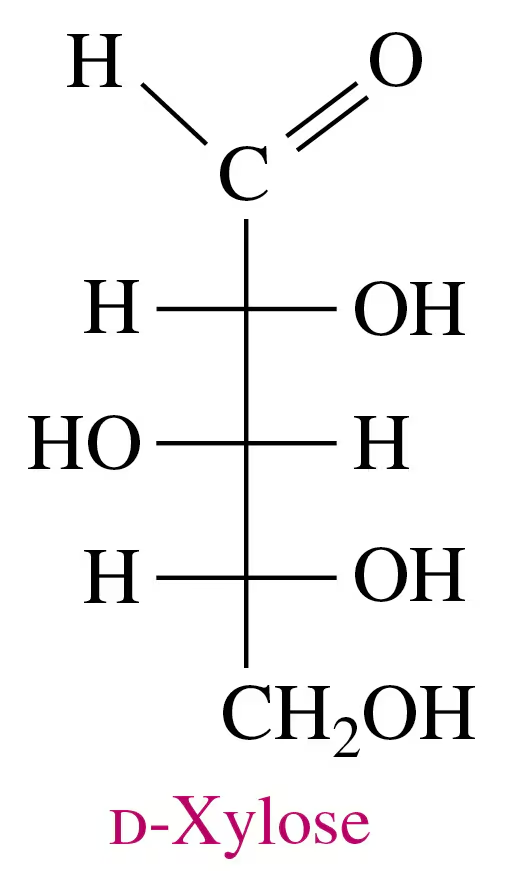
Draw the Fischer projection for the oxidation and the reduction products of D-xylose. What are the names of the sugar acid and the sugar alcohol produced?
Fischer projection of D-xylose showing its oxidation and reduction products, with labels for sugar acid and sugar alcohol.

검증된 단계별 안내
1
Understand the structure of D-xylose: D-xylose is a five-carbon aldose sugar (a monosaccharide with an aldehyde group). Its Fischer projection shows the arrangement of hydroxyl (-OH) groups and hydrogen atoms around the chiral carbons.
Oxidation of D-xylose: When D-xylose undergoes oxidation, the aldehyde group (-CHO) at the top of the Fischer projection is converted into a carboxylic acid group (-COOH). This forms a sugar acid. Draw the Fischer projection by replacing the aldehyde group with a carboxylic acid group while keeping the rest of the structure unchanged.
Reduction of D-xylose: When D-xylose undergoes reduction, the aldehyde group (-CHO) is converted into a primary alcohol group (-CH2OH). This forms a sugar alcohol. Draw the Fischer projection by replacing the aldehyde group with a primary alcohol group while keeping the rest of the structure unchanged.
Name the sugar acid: The sugar acid formed from the oxidation of D-xylose is called D-xylonic acid. This name reflects the conversion of the aldehyde group into a carboxylic acid group.
Name the sugar alcohol: The sugar alcohol formed from the reduction of D-xylose is called D-xylitol. This name reflects the conversion of the aldehyde group into a primary alcohol group.

비슷한 문제에 대한 검증된 영상 답변:

이 영상 해법은 위 문제에 도움이 된다고 튜터들이 추천한 것입니다.
영상 길이:
3m

주요 개념

질문에 올바르게 답하기 위해 반드시 이해해야 하는 핵심 개념들은 다음과 같습니다.

Fischer Projection

The Fischer projection is a two-dimensional representation of a molecule, particularly useful for depicting the stereochemistry of carbohydrates. In this format, the carbon skeleton is arranged vertically, with the most oxidized carbon at the top. Horizontal lines represent bonds that project out of the plane towards the viewer, while vertical lines represent bonds that extend behind the plane. This method is essential for visualizing the structure of sugars like D-xylose and understanding their stereoisomers.
추천 영상:
가이드 코스
0:48
Fischer Projections Example 1

Oxidation and Reduction in Sugars

Oxidation and reduction are chemical reactions that involve the transfer of electrons. In the context of sugars, oxidation typically refers to the conversion of an alcohol group (-OH) to a carbonyl group (C=O), resulting in the formation of sugar acids. Conversely, reduction involves the addition of electrons, often converting a carbonyl group back to an alcohol, leading to the formation of sugar alcohols. Understanding these processes is crucial for identifying the products of D-xylose.
추천 영상:
가이드 코스
0:50
Reduction of Monosaccharides Concept 1

Sugar Acid and Sugar Alcohol

Sugar acids and sugar alcohols are derivatives of carbohydrates formed through oxidation and reduction, respectively. A sugar acid, such as D-xylose's oxidation product, is characterized by the presence of a carboxylic acid group (-COOH), while a sugar alcohol, like the reduction product, contains multiple hydroxyl groups (-OH) and no carbonyl groups. Recognizing these compounds is important for understanding the biochemical pathways and applications of sugars in various contexts.
추천 영상:
가이드 코스
0:39
Common Naming of Sugar Alcohols Concept 3