
Ch.2 Chemistry and Measurements
Timberlake - Chemistry: An Introduction to General, Organic, and Biological Chemistry 14th Edition
Timberlake14th EditionChemistry: An Introduction to General, Organic, and Biological ChemistryISBN: 9781292472249당신이 사용하는 게 아니라요?교과서 변경
2장, 문제 77

In an old trunk, you find a piece of metal that you think may be aluminum, silver, or lead. You take it to a lab, where you find it has a mass of 217 g and a volume of 19.2 cm3. Using Table 2.10, what is the metal you found?

검증된 단계별 안내
1
Step 1: Recall the formula for density, which is \( \text{Density} = \frac{\text{Mass}}{\text{Volume}} \). This formula will help us calculate the density of the metal using the given mass and volume.
Step 2: Substitute the given values into the formula. The mass is 217 g and the volume is 19.2 cm3. The equation becomes \( \text{Density} = \frac{217}{19.2} \).
Step 3: Calculate the density using the substituted values. This will give you the density of the unknown metal in units of g/cm3.
Step 4: Compare the calculated density to the densities of aluminum, silver, and lead provided in Table 2.10. Each metal has a characteristic density, which can be used to identify the unknown metal.
Step 5: Based on the comparison, determine which metal has a density closest to the calculated value. This will allow you to identify the metal you found in the trunk.

비슷한 문제에 대한 검증된 영상 답변:

이 영상 해법은 위 문제에 도움이 된다고 튜터들이 추천한 것입니다.
영상 길이:
2m

주요 개념

질문에 올바르게 답하기 위해 반드시 이해해야 하는 핵심 개념들은 다음과 같습니다.

Density

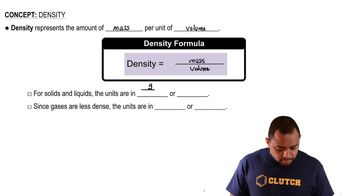
Density is defined as the mass of an object divided by its volume, typically expressed in grams per cubic centimeter (g/cm³). It is a crucial property for identifying materials, as different substances have unique densities. In this case, calculating the density of the metal found will help determine whether it is aluminum, silver, or lead by comparing it to known values.
추천 영상:

Material Properties

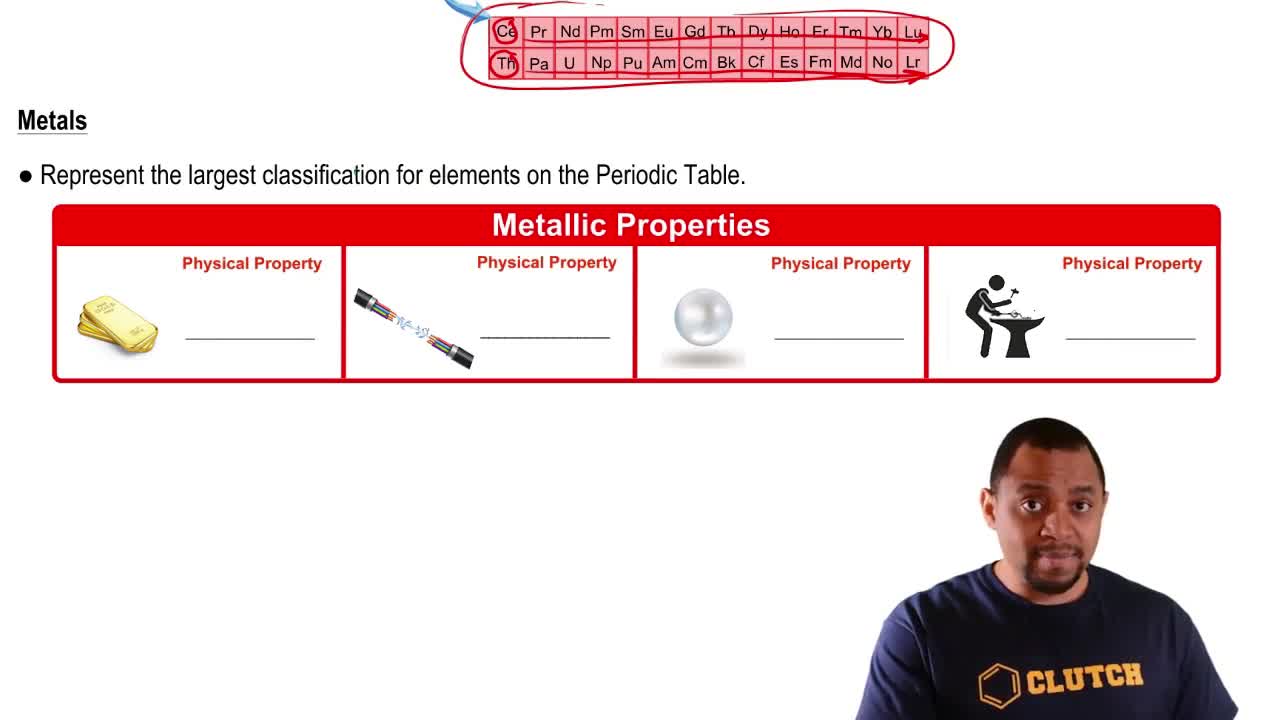
Material properties refer to the characteristics that define how a substance behaves under various conditions. For metals, properties such as density, melting point, and conductivity are essential for identification. Understanding these properties allows for the differentiation between metals like aluminum, silver, and lead, each of which has distinct physical and chemical attributes.
추천 영상:
가이드 코스
07:46
Laboratory Materials 2

Reference Tables

Reference tables, such as Table 2.10 mentioned in the question, provide standardized data for various materials, including their densities. These tables are essential tools in scientific analysis, allowing for quick comparisons between the calculated density of an unknown sample and the known densities of common materials. Utilizing these tables effectively aids in accurate identification of substances.
추천 영상:
가이드 코스
02:05
Periodic Table: Classifications