Ch.3 Matter and Energy
Timberlake - Chemistry: An Introduction to General, Organic, and Biological Chemistry 14th Edition
Timberlake14th EditionChemistry: An Introduction to General, Organic, and Biological ChemistryISBN: 9781292472249당신이 사용하는 게 아니라요?교과서 변경
3장, 문제 71d

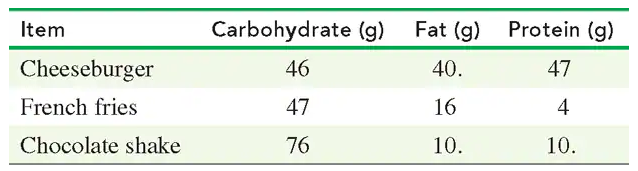
A 70.0-kg person had a quarter-pound cheeseburger, french fries, and a chocolate shake.

<IMAGE>
d. Using TABLE 3.10, determine the number of hours of running needed to burn off the kilocalories in this meal.

검증된 단계별 안내
1
Step 1: Identify the total kilocalories in the meal. Use the nutritional information provided in the problem or table to calculate the energy contribution from carbohydrates, fats, and proteins. Recall that carbohydrates and proteins provide 4 kcal/g, while fats provide 9 kcal/g.
Step 2: Sum the kilocalories from all components of the meal (cheeseburger, french fries, and chocolate shake). Ensure you account for the serving sizes and nutritional breakdown of each item.
Step 3: Refer to Table 3.10 to find the energy expenditure rate for running (e.g., kcal/hour for a 70.0-kg person). This table should provide the necessary data to determine how many kilocalories are burned per hour of running.
Step 4: Divide the total kilocalories of the meal by the energy expenditure rate for running. This calculation will give the number of hours required to burn off the meal.
Step 5: Interpret the result and ensure the units are consistent. If needed, round the number of hours to a reasonable decimal place for practical use.

비슷한 문제에 대한 검증된 영상 답변:

이 영상 해법은 위 문제에 도움이 된다고 튜터들이 추천한 것입니다.
영상 길이:
7m

주요 개념

질문에 올바르게 답하기 위해 반드시 이해해야 하는 핵심 개념들은 다음과 같습니다.

Caloric Content of Foods

Understanding the caloric content of foods is essential for determining how many calories a meal contains. Each macronutrient contributes a specific number of calories: carbohydrates and proteins provide 4 calories per gram, while fats provide 9 calories per gram. By calculating the total grams of each macronutrient in the meal, one can find the total caloric intake.
추천 영상:
가이드 코스
1:32
Intro to Citric Acid Cycle Concept 1

Metabolic Equivalent of Task (MET)

The Metabolic Equivalent of Task (MET) is a unit that estimates the energy expenditure of physical activities. Different activities, such as running, have specific MET values that indicate how many calories are burned per kilogram of body weight per hour. This concept is crucial for calculating how long a person needs to run to burn off the calories consumed in a meal.
추천 영상:
가이드 코스
01:43
Equivalents Concept 1

Energy Balance

Energy balance refers to the relationship between calories consumed through food and calories expended through physical activity. To maintain weight, the calories consumed must equal the calories burned. Understanding this concept helps in determining how much exercise is needed to offset caloric intake, such as the running required to burn off the calories from a meal.
추천 영상:
가이드 코스
01:26
Nature of Energy