Ch.7 Chemical Quantities and Reactions
Timberlake - Chemistry: An Introduction to General, Organic, and Biological Chemistry 14th Edition
Timberlake14th EditionChemistry: An Introduction to General, Organic, and Biological ChemistryISBN: 9781292472249당신이 사용하는 게 아니라요?교과서 변경
7장, 문제 76c

How would each of the following change the rate of the reaction shown here?
2 NO(g) + 2 H2(g) → N2(g) + 2 H2O(g)
c. removing some H2(g)

검증된 단계별 안내
1
Identify the factors that influence the rate of a chemical reaction. These include concentration of reactants, temperature, presence of a catalyst, and surface area (if applicable). In this case, we are focusing on the concentration of H₂(g).
Understand the role of H₂(g) in the reaction. According to the balanced equation, H₂(g) is a reactant, and its concentration directly affects the reaction rate based on the collision theory. Fewer H₂ molecules mean fewer collisions with NO molecules.
Apply the concept of the rate law. The rate law for this reaction would depend on the concentrations of the reactants. If the reaction is second-order with respect to H₂(g), the rate would be proportional to [H₂]². Removing some H₂ would decrease its concentration, thereby reducing the reaction rate.
Consider the effect of removing H₂(g) on the equilibrium. While this question focuses on reaction rate, note that removing a reactant can also shift the equilibrium position of the reaction (Le Chatelier's Principle), but this is separate from the immediate rate change.
Conclude that removing some H₂(g) decreases the frequency of effective collisions between H₂ and NO molecules, leading to a slower reaction rate.

비슷한 문제에 대한 검증된 영상 답변:

이 영상 해법은 위 문제에 도움이 된다고 튜터들이 추천한 것입니다.
영상 길이:
54s

주요 개념

질문에 올바르게 답하기 위해 반드시 이해해야 하는 핵심 개념들은 다음과 같습니다.

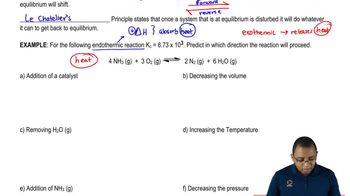
Le Chatelier's Principle

Le Chatelier's Principle states that if a dynamic equilibrium is disturbed by changing the conditions, the position of equilibrium shifts to counteract the change. In the context of a chemical reaction, if a reactant is removed, the equilibrium will shift to produce more of that reactant, thereby increasing the rate of the reaction until a new equilibrium is established.
추천 영상:
가이드 코스
09:34
The following is an endothermic reaction where Kc = 6.73 x 10³.For each of the choices below predict in which direction the reaction will proceed

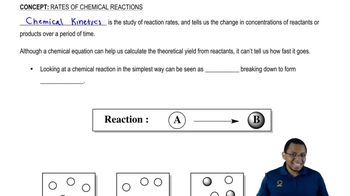
Reaction Rate

The reaction rate refers to the speed at which reactants are converted into products in a chemical reaction. It can be influenced by various factors, including concentration, temperature, and the presence of catalysts. In this case, removing H₂(g) decreases its concentration, which can slow down the reaction rate as there are fewer reactant molecules available to collide and react.
추천 영상:
가이드 코스
01:07
Rate of Reaction Concept 1

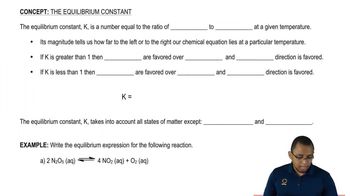
Equilibrium Constant (K)

The equilibrium constant (K) is a numerical value that expresses the ratio of the concentrations of products to reactants at equilibrium for a given reaction at a specific temperature. Changes in concentration, such as removing H₂(g), can affect the position of equilibrium but do not change the value of K. Understanding K helps predict how the system will respond to changes in concentration.
추천 영상:
가이드 코스
02:50
The Equilibrium Constant Concept 1