Ch.8 Gases
Timberlake - Chemistry: An Introduction to General, Organic, and Biological Chemistry 14th Edition
Timberlake14th EditionChemistry: An Introduction to General, Organic, and Biological ChemistryISBN: 9781292472249당신이 사용하는 게 아니라요?교과서 변경
8장, 문제 2b

Use the kinetic molecular theory of gases to explain each of the following:
b. The air in a hot-air balloon is heated to make the balloon rise.

검증된 단계별 안내
1
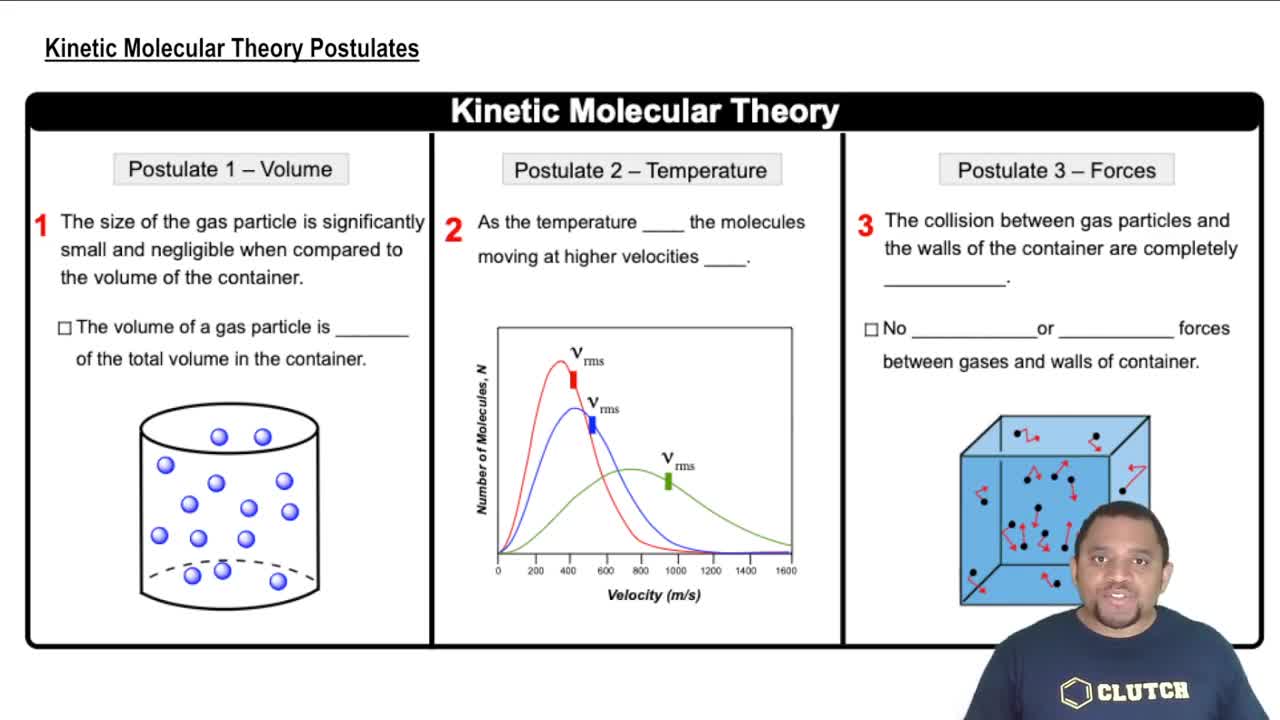
The kinetic molecular theory of gases states that gas particles are in constant, random motion and that their kinetic energy is directly proportional to the temperature of the gas. This means that as the temperature of a gas increases, the average kinetic energy of its particles also increases.
When the air inside the hot-air balloon is heated, the temperature of the gas increases. According to the kinetic molecular theory, this causes the gas particles to move faster and spread out, increasing the volume of the gas if the pressure remains constant.
As the volume of the heated air increases, the density of the air inside the balloon decreases because density is defined as mass per unit volume (\( \text{Density} = \frac{\text{Mass}}{\text{Volume}} \)).
The lower density of the heated air inside the balloon compared to the cooler, denser air outside creates a buoyant force. This buoyant force is what causes the hot-air balloon to rise.
In summary, the heating of the air inside the balloon reduces its density, and the difference in density between the inside and outside air allows the balloon to rise due to the buoyant force acting on it.

비슷한 문제에 대한 검증된 영상 답변:

이 영상 해법은 위 문제에 도움이 된다고 튜터들이 추천한 것입니다.
영상 길이:
1m

주요 개념

질문에 올바르게 답하기 위해 반드시 이해해야 하는 핵심 개념들은 다음과 같습니다.

Kinetic Molecular Theory

The kinetic molecular theory explains the behavior of gases in terms of particles in constant motion. It posits that gas particles are small, widely spaced, and move randomly at high speeds. This theory helps to understand how temperature affects the energy and movement of gas particles, which is crucial for explaining phenomena like the behavior of air in a hot-air balloon.
추천 영상:
가이드 코스
01:19
Kinetic Molecular Theory Concept 1

Temperature and Kinetic Energy

Temperature is a measure of the average kinetic energy of the particles in a substance. In the context of a hot-air balloon, heating the air increases the kinetic energy of the air molecules, causing them to move faster and collide more forcefully with each other. This increase in kinetic energy results in a decrease in air density, allowing the balloon to rise as the warmer, lighter air becomes buoyant compared to the cooler, denser air outside.
추천 영상:
가이드 코스
03:23
Kinetic Molecular Theory Concept 2

Buoyancy

Buoyancy is the upward force exerted by a fluid that opposes the weight of an object immersed in it. In the case of a hot-air balloon, the heated air inside the balloon is less dense than the cooler air outside, creating a buoyant force. This difference in density allows the balloon to rise, as the buoyant force acting on it exceeds the gravitational force pulling it down.