Skip to main content
Intermediate Algebra
나의 코스
배우기
시험 준비
AI 튜터
학습 가이드
플래시카드
탐험해 보세요
앱을 사용해 보세요
나의 코스
배우기
시험 준비
AI 튜터
학습 가이드
플래시카드
탐험해 보세요
앱을 사용해 보세요
뒤로
Solving Rational Equations in Intermediate Algebra
카드를 뒤집기 위해 탭할 수 있습니다.
What is the first step in solving a rational equation?
카드를 뒤집기 위해 탭할 수 있습니다.
👆
What is the first step in solving a rational equation?
Factor each denominator.
진행 상황 추적
컨트롤 버튼이 '내비게이션' 모드로 변경되었습니다.
1/27
추천 영상
VideoThumbView.guidedCourse
05:21
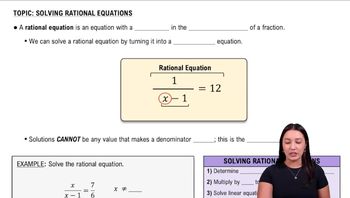
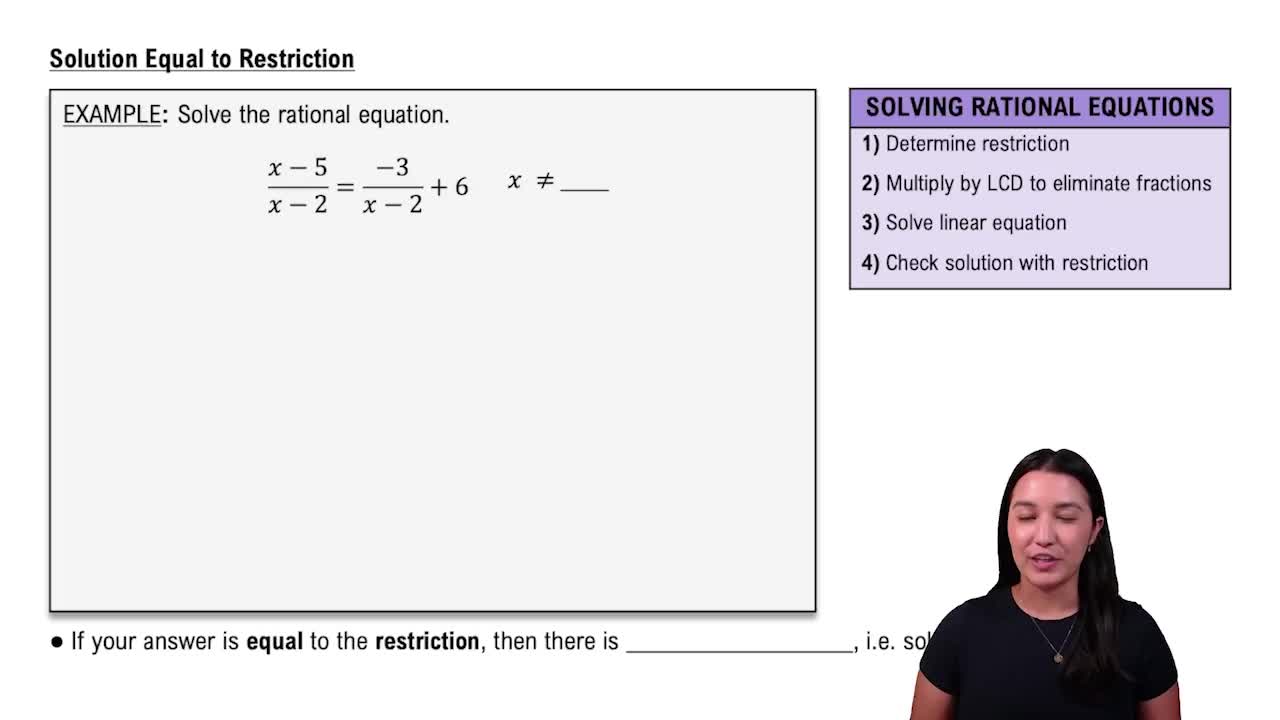
Restrictions on Rational Equations
147
views
2
rank
VideoThumbView.guidedCourse
08:59
Solving Rational Equations Example 1
159
views
2
rank
VideoThumbView.guidedCourse
05:56
Solving Rational Equations
235
views
5
rank
이 집합의 용어 (27)
하이드의 정의
What is the first step in solving a rational equation?
Factor each denominator.
What are non-permissible values (NPVs) in rational equations?
Values that make any denominator zero and must be excluded from solutions.
What is the purpose of multiplying both sides of a rational equation by the LCD?
To eliminate denominators and simplify the equation.
How do you check for extraneous solutions in rational equations?
Verify that solutions are not NPVs; if they are, reject them as extraneous.
In the equation \(\frac{x}{2} + 3 = 2 + \frac{3x}{4}\), what is the LCD?
4
What is the solution to \(\frac{x}{2} + 3 = 2 + \frac{3x}{4}\) after multiplying by the LCD and solving?
x = 4
For the equation \(\frac{2x + 3}{x + 5} + \frac{1}{2} = \frac{7}{2x + 10}\), what are the NPVs?
x ≠ -5
What is the LCD for \(\frac{2x + 3}{x + 5} + \frac{1}{2} = \frac{7}{2x + 10}\)?
2(x + 5)
What is the solution to \(\frac{2x + 3}{x + 5} + \frac{1}{2} = \frac{7}{2x + 10}\) after multiplying by the LCD and simplifying?
x = -\(\frac{4}{5}\)
How do you factor the denominator \(x^2 - 4\)?
As (x - 2)(x + 2)
What are the NPVs for the equation with denominators \(x^2 - 4\) and \(6x + 12\)?
x ≠ 2, -2
What is the LCD for denominators (x - 2)(x + 2) and 6(x + 2)?
6(x + 2)(x - 2)
What is the solution to \(\frac{2}{x^2 - 4} + \frac{10}{6x + 12} = \frac{1}{x - 2}\) after multiplying by the LCD and simplifying?
x = 5
How do you factor \(k^2 - 4\)?
As (k + 2)(k - 2)
What are the NPVs for the equation with denominator \(k^2 - 4\)?
k ≠ -2, 2
What is the LCD for denominators (k + 2), (k - 2), and (k^2 - 4)?
(k + 2)(k - 2)
After multiplying by the LCD and simplifying, what quadratic equation results from \(\frac{4k - 1}{k + 2} - \frac{k + 1}{k - 2} = \frac{k^2 - 4k + 24}{k^2 - 4}\)?
2k^2 - 8k - 24 = 0
What are the possible solutions to 2(k + 2)(k - 6) = 0?
k = -2 or k = 6
Which solution must be rejected for the equation with NPVs k ≠ -2, 2?
k = -2
What is the final solution for the equation \(\frac{4k - 1}{k + 2} - \frac{k + 1}{k - 2} = \frac{k^2 - 4k + 24}{k^2 - 4}\)?
k = 6
How do you factor \(x^2 - x - 6\)?
As (x + 2)(x - 3)
What are the NPVs for the equation with denominator \(x^2 - x - 6\)?
x ≠ -2, 3
What is the LCD for denominators (x + 2) and (x - 3)?
(x + 2)(x - 3)
What quadratic equation results from multiplying and simplifying \(\frac{3x}{x + 2} - \frac{5}{x - 3} = \frac{-25}{x^2 - x - 6}\)?
3x^2 - 14x - 15 = 0
What are the possible solutions to (3x - 5)(x - 3) = 0?
x = \(\frac{5}{3}\) or x = 3
Which solution must be rejected due to NPVs in the equation with denominators (x + 2)(x - 3)?
x = 3
What is the final solution to \(\frac{3x}{x + 2} - \frac{5}{x - 3} = \frac{-25}{x^2 - x - 6}\)?
x = \(\frac{5}{3}\)
 뒤로뒤로
 05:21