Skip to main content
Introductory Biology
나의 코스
배우기
시험 준비
AI 튜터
학습 가이드
플래시카드
탐험해 보세요
앱을 사용해 보세요
나의 코스
배우기
시험 준비
AI 튜터
학습 가이드
플래시카드
탐험해 보세요
앱을 사용해 보세요
뒤로
Introductory Biology: DNA, Cells, and Biotechnology
카드를 뒤집기 위해 탭할 수 있습니다.
Where and how is DNA stored in a eukaryotic cell?
카드를 뒤집기 위해 탭할 수 있습니다.
👆
Where and how is DNA stored in a eukaryotic cell?
DNA is stored in the nucleus. It wraps around
histone proteins
to form chromatin, which coils and folds into chromosomes.
진행 상황 추적
컨트롤 버튼이 '내비게이션' 모드로 변경되었습니다.
1/30
추천 영상
VideoThumbView.guidedCourse
06:52
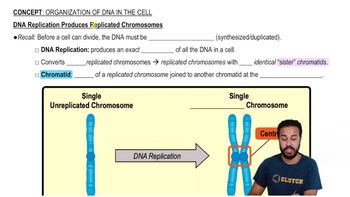
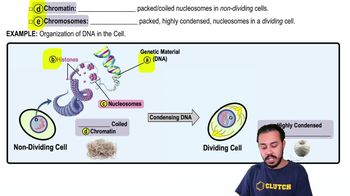
Organization of DNA in the Cell
204
views
3
rank
VideoThumbView.guidedCourse
05:46
DNA Replication
172
views
1
rank
이 집합의 용어 (30)
하이드의 정의
Where and how is DNA stored in a eukaryotic cell?
DNA is stored in the nucleus. It wraps around
histone proteins
to form chromatin, which coils and folds into chromosomes.
What is DNA made of?
DNA is made of
nucleotides
. Each nucleotide contains a sugar, phosphate group, and nitrogenous base.
What are DNA’s four nitrogenous bases?
Adenine, thymine, cytosine, and guanine.
What are the DNA base-pairing rules?
Adenine pairs with thymine, and cytosine pairs with guanine.
What does semi-conservative DNA replication mean?
Each new DNA molecule contains one original strand and one newly created strand.
What is the role of helicase during DNA replication?
Helicase separates or “unzips” the two DNA strands.
What does DNA polymerase do?
DNA polymerase adds complementary nucleotides to create new DNA strands.
What is the function of DNA ligase?
DNA ligase connects DNA fragments together.
How can errors during DNA replication lead to mutations?
If the wrong nucleotide is added and not repaired, the error becomes a permanent change in the DNA sequence.
How can a DNA mutation affect a cell?
A mutation can change RNA, which may change the amino acid sequence and function of a protein.
What are short tandem repeats (STRs)?
STRs are short DNA sequences repeated several times. The number of repeats varies between individuals.
What is the central dogma of molecular biology?
DNA → RNA → protein.
What is transcription?
Transcription is the process of copying DNA information into RNA.
What is translation?
Translation is the process of using RNA instructions to build a protein.
What are the three major regions of a eukaryotic cell?
The nucleus, cytoplasm, and plasma membrane.
What is the function of the plasma membrane?
It surrounds the cell and controls what enters and leaves.
What is the difference between eukaryotic and prokaryotic cells?
Eukaryotic cells have a nucleus and membrane-bound organelles; prokaryotic cells do not.
What is the function of mitochondria?
They produce ATP energy through cellular respiration.
What is the function of chloroplasts?
They perform photosynthesis in plant cells.
What organelle builds proteins?
Ribosomes.
What is the function of the rough endoplasmic reticulum (ER)?
It contains ribosomes and helps produce and transport proteins.
What are three differences between DNA and RNA?
DNA is usually double-stranded, contains deoxyribose, and uses thymine. RNA is usually single-stranded, contains ribose, and uses uracil.
What happens during transcription?
DNA is used as a template to create complementary mRNA in the nucleus.
What happens during translation?
Ribosomes read mRNA codons and join amino acids together to form a protein.
What is a codon?
A group of three RNA nucleotides that codes for an amino acid.
What is PCR (polymerase chain reaction)?
A technique used to make millions of copies of a specific DNA region.
What is DNA sequencing?
Determining the exact order of nucleotides in a DNA molecule.
What is gel electrophoresis used for?
It separates DNA fragments by size so they can be compared.
What is a genetically modified organism (GMO)?
An organism whose genetic material has been artificially changed.
What is a transgenic organism?
An organism that receives a gene from another species.
 뒤로뒤로
 06:52