Balance each of the following chemical equations:
c. Sb₂S₃(s) + HCl(aq) → SbCl₃(aq) + H₂S(g)
검증된 단계별 안내
1
Identify the number of each type of atom on both sides of the equation. For the reactants: Sb: 2, S: 3, H: 1, Cl: 1. For the products: Sb: 1, Cl: 3, H: 2, S: 1.
Start by balancing the element that appears in the least number of compounds. In this case, balance the antimony (Sb) atoms by placing a coefficient of 2 in front of SbCl₃ on the product side.
Next, balance the sulfur (S) atoms. Since there are 3 sulfur atoms in Sb₂S₃, place a coefficient of 3 in front of H₂S on the product side.
Now, balance the hydrogen (H) atoms. There are 6 hydrogen atoms needed on the product side (from 3 H₂S), so place a coefficient of 6 in front of HCl on the reactant side.
Finally, balance the chlorine (Cl) atoms. There are 6 chlorine atoms on the reactant side (from 6 HCl), which matches the 6 chlorine atoms on the product side (from 2 SbCl₃).
비슷한 문제에 대한 검증된 영상 답변:
이 영상 해법은 위 문제에 도움이 된다고 튜터들이 추천한 것입니다.
영상 길이:
4m
영상 재생:
0 댓글
주요 개념
질문에 올바르게 답하기 위해 반드시 이해해야 하는 핵심 개념들은 다음과 같습니다.
Chemical Equation
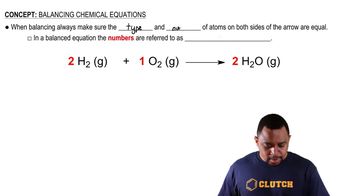
A chemical equation represents a chemical reaction using symbols and formulas. It shows the reactants on the left side and the products on the right, separated by an arrow. Balancing a chemical equation ensures that the number of atoms for each element is the same on both sides, adhering to the law of conservation of mass.
Balancing Chemical Equations (Simplified) Concept 1
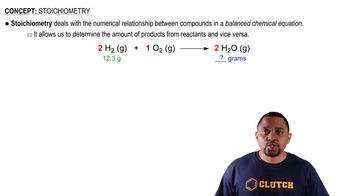
Stoichiometry
Stoichiometry is the calculation of reactants and products in chemical reactions. It involves using the coefficients in a balanced equation to determine the proportions of substances involved. Understanding stoichiometry is essential for balancing equations, as it helps identify the correct ratios of reactants and products.
In chemical equations, the states of matter indicate the physical form of the substances involved. Common states include solid (s), liquid (l), gas (g), and aqueous (aq). Recognizing these states is important for understanding the behavior of substances during a reaction and for accurately balancing the equation.

 4:23분
 검증된 단계별 안내

 01:32