The diagram to the right shows plots of vapor pressure versus temperature for a solvent and a solution.
What is the approximate concentration of the solution in mol/kg, if 1 mol of solute particles raises the boiling point of 1 kg of solvent by 3.63 °C?
검증된 단계별 안내
1
Identify the boiling points of the pure solvent and the solution from the graph where the vapor pressure is 760 mmHg.
Calculate the boiling point elevation by subtracting the boiling point of the pure solvent from the boiling point of the solution.
Use the formula for boiling point elevation: \( \Delta T_b = i \cdot K_b \cdot m \), where \( \Delta T_b \) is the boiling point elevation, \( i \) is the van't Hoff factor, \( K_b \) is the ebullioscopic constant, and \( m \) is the molality.
Assume the van't Hoff factor \( i \) is 1 for a non-electrolyte solute, and use the given \( K_b = 3.63 \, ^\circ C \cdot kg/mol \).
Solve for the molality \( m \) by rearranging the formula: \( m = \frac{\Delta T_b}{K_b} \).
비슷한 문제에 대한 검증된 영상 답변:
이 영상 해법은 위 문제에 도움이 된다고 튜터들이 추천한 것입니다.
영상 길이:
2m
영상 재생:
0 댓글
주요 개념
질문에 올바르게 답하기 위해 반드시 이해해야 하는 핵심 개념들은 다음과 같습니다.
Vapor Pressure
Vapor pressure is the pressure exerted by a vapor in equilibrium with its liquid or solid phase at a given temperature. It indicates how readily a substance will evaporate; higher vapor pressure means a substance evaporates more easily. In the context of the question, the vapor pressure of the solvent decreases when a solute is added, affecting the boiling point.
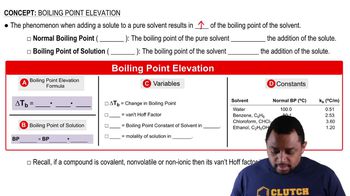
Boiling point elevation is a colligative property that describes how the boiling point of a solvent increases when a solute is dissolved in it. The extent of this elevation is directly proportional to the number of solute particles in the solution. The formula ΔT_b = i * K_b * m is used, where ΔT_b is the change in boiling point, i is the van 't Hoff factor, K_b is the ebullioscopic constant, and m is the molality of the solution.
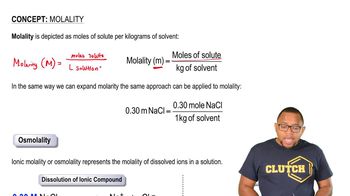
Molality (m) is a measure of concentration defined as the number of moles of solute per kilogram of solvent. It is particularly useful in colligative properties because it does not change with temperature. In this question, calculating the molality of the solution is essential to determine how many moles of solute are needed to achieve the specified boiling point elevation.