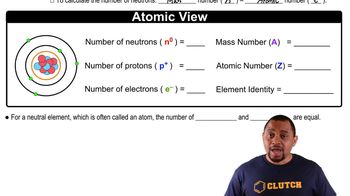
Consider the following atoms in which X represents the chemical symbol of the element: (4.4, 4.5) ¹⁶₈X ¹⁶₉X ¹⁸₁₀X ¹⁷₈X ¹⁸₈X
a. What atoms have the same number of protons?
검증된 단계별 안내
1
Identify the atomic number (subscript) for each atom, which represents the number of protons.
List the atomic numbers: 33, 34, 33, 35, 33.
Group the atoms with the same atomic number.
Atoms with atomic number 33 are: 75/33X, 78/33X, 77/33X.
Conclude that these atoms have the same number of protons.
비슷한 문제에 대한 검증된 영상 답변:
이 영상 해법은 위 문제에 도움이 된다고 튜터들이 추천한 것입니다.
영상 길이:
1m
영상 재생:
0 댓글
주요 개념
질문에 올바르게 답하기 위해 반드시 이해해야 하는 핵심 개념들은 다음과 같습니다.
Atomic Number
The atomic number of an element is the number of protons found in the nucleus of its atoms. It uniquely identifies an element and determines its position on the periodic table. In the context of isotopes, atoms with the same atomic number belong to the same element, regardless of their mass number.
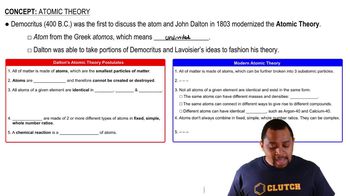
Isotopes are variants of a particular chemical element that have the same number of protons but different numbers of neutrons, resulting in different mass numbers. For example, the isotopes of element X in the question share the same atomic number but differ in their mass numbers, indicating variations in their neutron count.
The mass number of an atom is the total number of protons and neutrons in its nucleus. It is represented as the superscript in the notation of an isotope (e.g., ¹⁶₈X). Understanding mass number is crucial for distinguishing between different isotopes of the same element, as it reflects the total nuclear composition.

 1:45분
1:45분
 검증된 단계별 안내
 05:22
05:22