Skip to main content
Introduction to Chemistry
나의 코스
배우기
시험 준비
AI 튜터
학습 가이드
플래시카드
탐험해 보세요
앱을 사용해 보세요
나의 코스
배우기
시험 준비
AI 튜터
학습 가이드
플래시카드
탐험해 보세요
앱을 사용해 보세요
뒤로
The Ideal Gas Law Applications quiz
카드를 뒤집기 위해 탭할 수 있습니다.
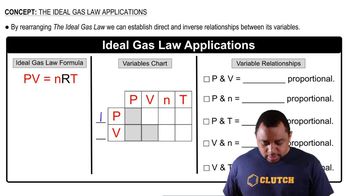
What is the formula for the ideal gas law?
카드를 뒤집기 위해 탭할 수 있습니다.
👆
What is the formula for the ideal gas law?
The formula is PV = nRT.
진행 상황 추적
컨트롤 버튼이 '내비게이션' 모드로 변경되었습니다.
1/15
관련 플래시카드
관련 실천
추천 영상
The Ideal Gas Law Applications definitions
The Ideal Gas Law Applications
13 용어
The Ideal Gas Law Applications
11 Gases
5 문제점
주제
Chemistry Gas Laws
11 Gases
5 문제점
주제
11 Gases
10 주제
26 문제점
장
VideoThumbView.guidedCourse
01:09
The Ideal Gas Law Applications Example 1
7040
views
42
rank
VideoThumbView.guidedCourse
04:09
The Ideal Gas Law Applications
7876
views
43
rank
이 집합의 용어 (15)
하이드의 정의
What is the formula for the ideal gas law?
The formula is PV = nRT.
Which variable in the ideal gas law is considered a constant and can be ignored when analyzing variable relationships?
R, the gas constant, is considered a constant and can be ignored.
What type of relationship exists between pressure and volume in the ideal gas law?
Pressure and volume have an inverse relationship.
If pressure increases while other variables are constant, what happens to volume?
Volume decreases because pressure and volume are inversely proportional.
How are pressure and moles related in the ideal gas law?
Pressure and moles are directly proportional; increasing one increases the other.
What happens to pressure if the number of moles increases, assuming other variables are constant?
Pressure increases because it is directly proportional to the number of moles.
Describe the relationship between pressure and temperature in the ideal gas law.
Pressure and temperature are directly proportional; increasing one increases the other.
If temperature increases and all other variables are constant, what happens to pressure?
Pressure increases because it is directly proportional to temperature.
How are volume and moles related according to the ideal gas law?
Volume and moles are directly proportional; increasing one increases the other.
What happens to the volume if the number of moles increases, with other variables constant?
Volume increases because it is directly proportional to the number of moles.
What is the relationship between volume and temperature in the ideal gas law?
Volume and temperature are directly proportional.
If volume increases, what happens to temperature if all other variables are constant?
Temperature increases because volume and temperature are directly proportional.
Which pair of variables in the ideal gas law exhibits an inverse relationship?
Only pressure and volume exhibit an inverse relationship.
When analyzing variable relationships in the ideal gas law, why can R be ignored?
R is a constant and does not affect the proportional relationships between the other variables.
If both pressure and volume are increased simultaneously, what can you say about their relationship?
They are inversely proportional, so increasing both at the same time is not possible if other variables are constant.
 뒤로뒤로
뒤로뒤로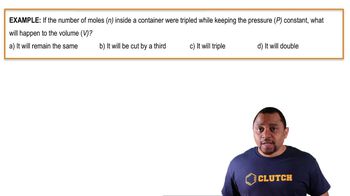
 01:09
01:09