 뒤로
Ch. 12- Solutions
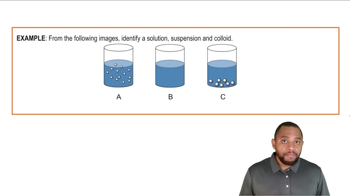
 01:16

이 집합의 용어 (35)
Solution
A homogenous mixture of 2 or more substances
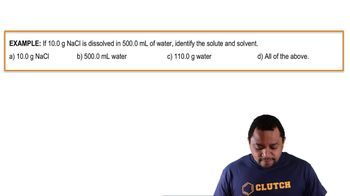
Solute
The smaller quantity of the solution
Solvent
The larger quantity of the solution
Solutes CANNOT be separated by
filtration
Soltes CAN be separated by
evaporation
Water, the most common solvent,
Is polar and forms H-bonds between molecules
When the solute & solution are SIMILAR in polarity,
attractive forces occur
Like...
dissolves like
In the formation of a solution,
a solid seperates into ions
True or False: Nonpolar solutes dissolve in polar water.
False
Nonpolar molecules in a nonpolar solvent form a
solution
In water, strong electrolytes
Break up completely into ions & produce electricity
In water, weak electrolytes
Dissolve mostly as molecules (with a few ions) & conduct a weak current
In water, non-electrolytes
Dissolve as molecules and produce no ions or electricity
What ions do soluble salts contain AT LEAST ONE of?
From Group 1A, NO3-, or C2H3O2-
True or False: The soluble typically overrules the insoluble.
True
An ionic equation
shows all the ionic compounds as separate ions
A net ionic equation
shows only the ions that react to form a solid
molarity=
moles/liters
In a dilution,
a solvent is added to a solution to increase the volume
What is the formula for a dilution?
C1 V1= C2 V2
As volume increases,
concentration decreases
Volume and molarity are used to determine
the moles of a reactant/product (V * M = moles)
What is the formula for molarity?
M = moles/liters
mass percent=
mass component / total mass * 100
As pressure increases, the solubility of a gas
increases
As temperature increases, the solubility of a gas
decreases
As temperature increases, the solubility of most solids
increases
Tb (boiling point)=
m * Kb
Kb=
0.512 degrees Celsius kg/solvent
Tf (freezing point)=
m * Kf
Kf=
1.86 degrees Celsius kg/solvent
Saturated solutions
Contain the maximum amount of solute
Unsaturated solutions
Contain less than the maximum amount of solute
As the gas pressure above a liquid increases,
solubility increases