 뒤로
뒤로Introduction to Chemistry: Acids, Bases & Organic Chemistry
 01:30
01:30
이 집합의 용어 (20)
An acid can give away a proton (H+), and a base can take a proton.
Acidic: more H3O+ than OH−; Neutral: equal amounts of H3O+ and OH−; Basic: more OH− than H3O+.
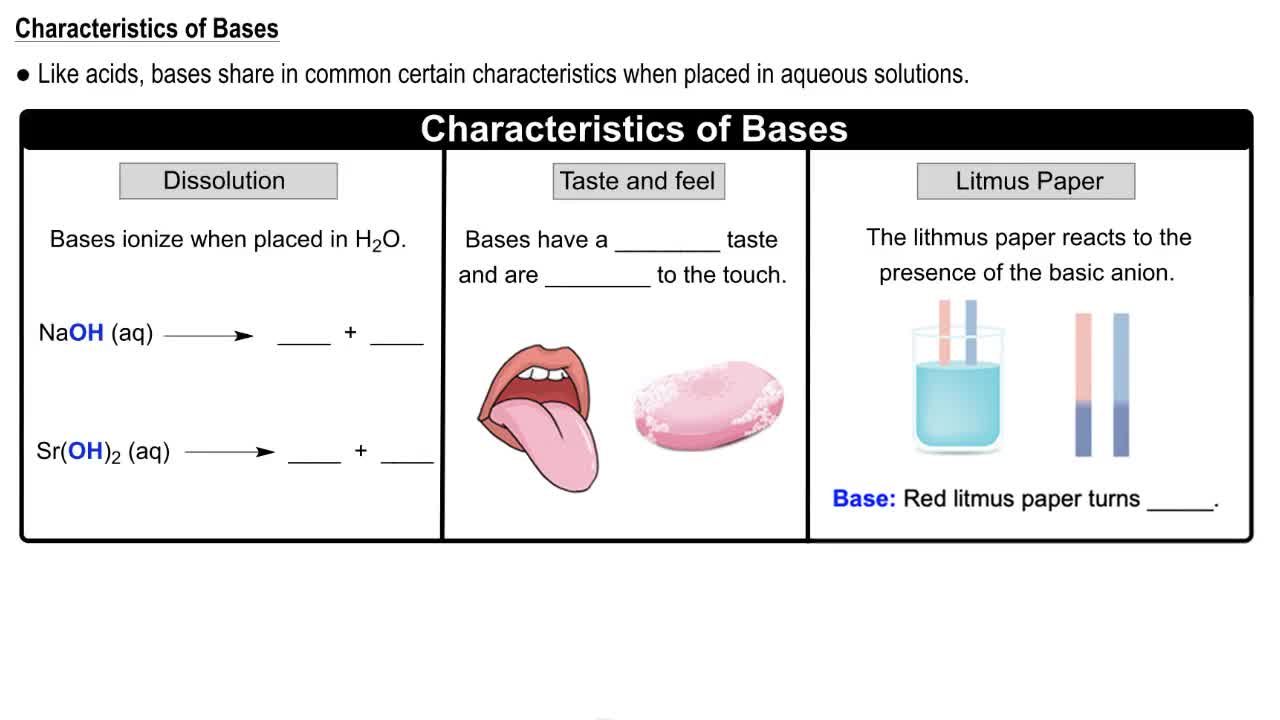
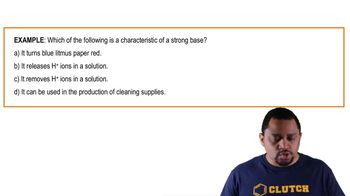
Acids turn blue litmus paper red, while bases turn red litmus paper blue.
Strong acids give up nearly all their protons in water; weak acids give up only some protons, with many molecules remaining intact.
Concentrated means a lot of dissolved substance in a volume; dilute means less dissolved substance in that volume.
Monoprotic: donates one proton per molecule; diprotic: donates two protons in separate steps; triprotic: donates three protons in separate steps.
pH measures acidity: below 7 is acidic, 7 is neutral, above 7 is basic. Lower pH means more hydronium ions.
\(\mathrm{pH} = -\log_{10}[\mathrm{H_3O^+}]\) and \([\mathrm{H_3O^+}] = 10^{-\mathrm{pH}}\).
Two species that differ by one proton (H+), such as an acid and the particle left after it donates a proton.
Water and a salt (an ionic compound) are formed in acid-base neutralization.
They produce a salt and hydrogen gas.
Titration uses a solution of known concentration to find the concentration of an unknown solution by reacting them and using the balanced equation.
Alkane: \(\mathrm{C_nH_{2n+2}}\), Alkene: \(\mathrm{C_nH_{2n}}\), Alkyne: \(\mathrm{C_nH_{2n-2}}\).
Saturated hydrocarbons have only single bonds; unsaturated have one or more double or triple bonds.
Find the longest chain, number it giving multiple bonds lowest numbers, identify branches and their positions, then combine branch names alphabetically with the main chain name and appropriate suffix.
Compounds with the same molecular formula but different connections between atoms.
Benzene is a six-carbon ring with shared electrons, formula \(\mathrm{C_6H_6}\), and is called aromatic.
A small group of atoms that controls how a molecule behaves, e.g., alcohol (R–OH), ether (R–O–R), carboxylic acid (R–C(=O)–OH).
Atoms add across a carbon–carbon double or triple bond, such as hydrogenation where H2 is added.
Hydrocarbon + oxygen → carbon dioxide + water.