 뒤로
Introduction to Chemistry: Gas Laws
 03:20

이 집합의 용어 (20)
Boyle's Law states that the pressure of a gas is inversely proportional to its volume at constant temperature. Mathematically, \(P \propto \frac{1}{V}\) or \(P V = k\).
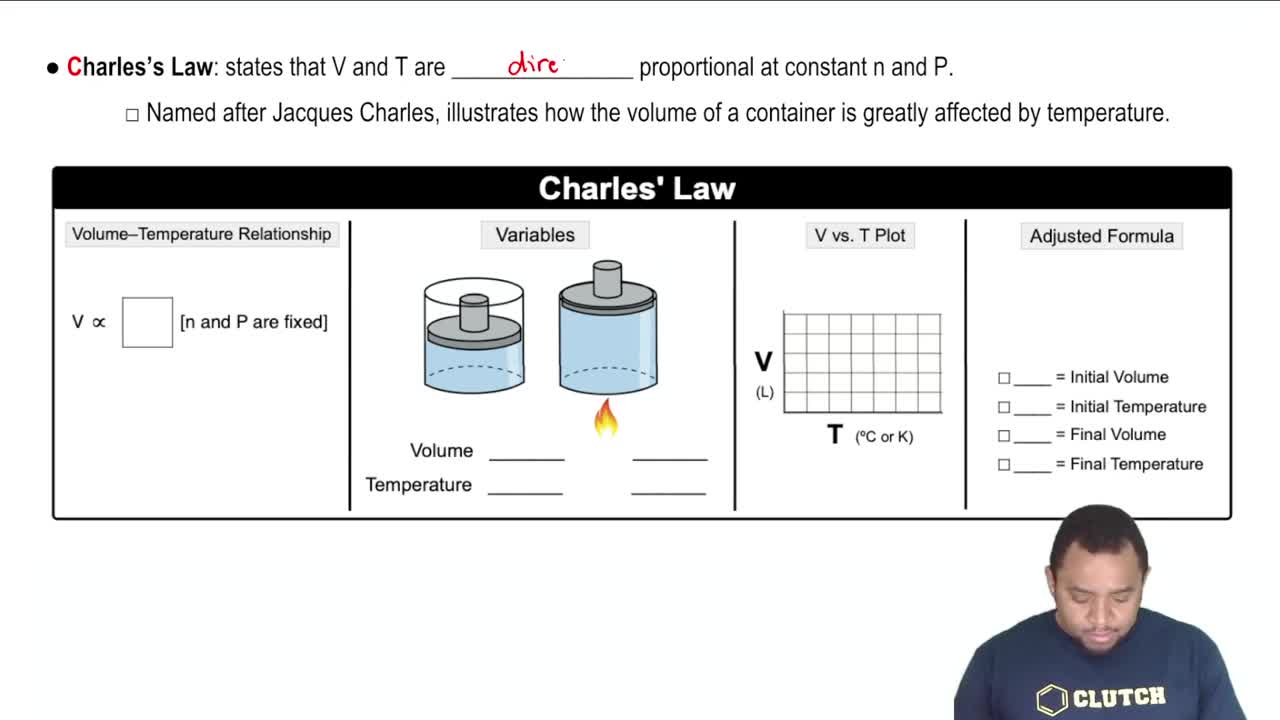
Charles's Law states that the volume of a gas is directly proportional to its absolute temperature at constant pressure. Expressed as \(V \propto T\) or \(\frac{V}{T} = k\).
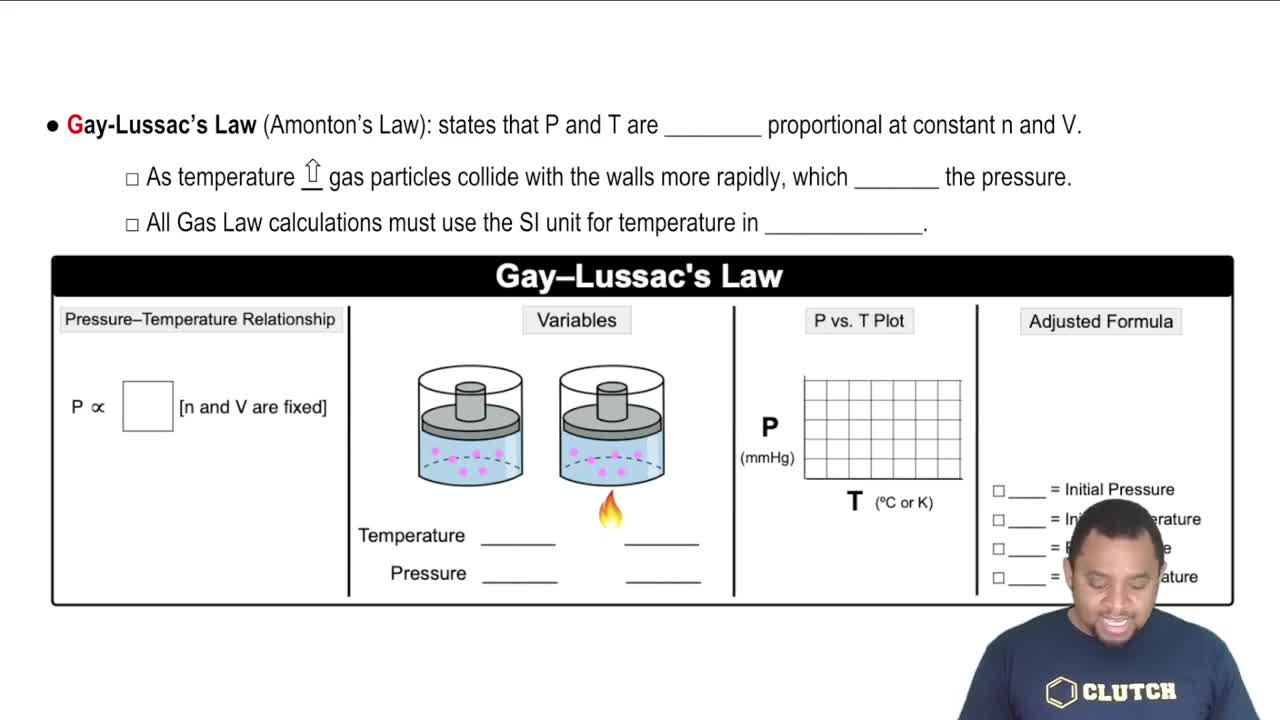
Gay-Lussac's Law states that the pressure of a gas is directly proportional to its absolute temperature at constant volume. Written as \(P \propto T\) or \(\frac{P}{T} = k\).
The Ideal Gas Law combines gas laws into one equation: \(PV = nRT\), where P is pressure, V is volume, n is moles, R is the gas constant, and T is temperature in Kelvin.
Temperature must be in Kelvin for all gas law calculations to ensure proportionality and correctness.
Pressure and volume are inversely proportional; as volume decreases, pressure increases if temperature is constant.
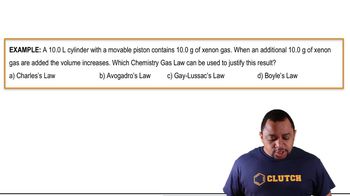
Avogadro's Law states that volume is directly proportional to the number of moles of gas at constant temperature and pressure: \(V \propto n\).
The Combined Gas Law relates pressure, volume, and temperature: \(\frac{P_1 V_1}{T_1} = \frac{P_2 V_2}{T_2}\).
The gas constant R is commonly 0.0821 L·atm/mol·K when pressure is in atm and volume in liters.
Convert Celsius to Kelvin by adding 273.15: \(K = ^\circ C + 273.15\).
STP is defined as 0°C (273.15 K) and 1 atm pressure, used as a reference for gas calculations.
Increasing temperature increases gas pressure if volume is constant, as particles move faster and collide more forcefully.
Dalton's Law states total pressure of a gas mixture equals the sum of partial pressures of individual gases: \(P_{total} = P_1 + P_2 + ...\).
Assumes gas particles have negligible volume and no intermolecular forces, and collisions are elastic.
Volume increases as temperature increases at constant pressure, according to Charles's Law.
Volume is directly proportional to moles of gas, per Avogadro's Law.
Absolute zero (0 K) is the theoretical temperature where gas volume and pressure reach zero, representing no particle motion.
Rearranged: \(n = \frac{PV}{RT}\).
Pressure doubles, according to Boyle's Law.
Because Kelvin is an absolute scale starting at zero, ensuring proportional relationships in gas laws.