 뒤로
Unit 4 - Electrons
 01:14

이 집합의 용어 (20)
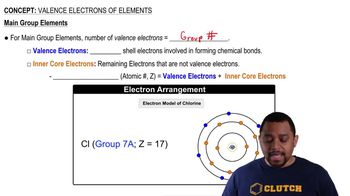
Valence electrons are the outermost electrons in an atom that participate in chemical bonding.
Write the element symbol and draw valence electrons as dots around it, placing one electron on each side before pairing them up.
Light is a form of electromagnetic radiation, energy that travels through space at a constant speed as waves or particles called photons.
Wavelength (𝜆) is the distance between waves, measured in nanometers (nm).
Frequency (𝜈) is the number of waves passing a point per second, measured in inverse seconds (1/s).
The speed of light c is 3.00x10⁸ m/s, related by \(\lambda \times \nu = c\).
Energy E of a photon is calculated by \(E = h \nu\), where h is Planck's constant (6.626x10⁻³⁴ J·s).
It is the light emitted by atoms when electrons drop to lower energy levels, producing unique wavelengths for each element.
Atoms ionize to achieve 8 valence electrons, forming cations (positive) or anions (negative).
Cation is an ion that loses electrons and is positive; Anion gains electrons and is negative.
It is the force of attraction between positive and negative charges in atoms.
Atomic radius is the size of an atom, measured from the nucleus to the outermost electrons.
Ionization energy is the energy required to remove the outermost electron from an atom.
Electronegativity is an atom's ability to attract electrons to its nucleus.
It explains atomic behavior better than the Bohr model, describing electrons in orbitals with probabilistic locations.
Orbitals are regions where electrons have the highest probability of being found.
Electrons fill from the lowest energy orbital up, placing one electron per orbital before pairing with opposite spins.
It is the notation that shows the distribution of electrons in an atom's orbitals.
Write the neutral atom configuration, then add or remove electrons according to the ion's charge.
Start from the nearest previous noble gas in brackets, then continue filling orbitals to the element.