Skip to main content
Macroeconomics
나의 코스
배우기
시험 준비
AI 튜터
학습 가이드
플래시카드
탐험해 보세요
앱을 사용해 보세요
나의 코스
배우기
시험 준비
AI 튜터
학습 가이드
플래시카드
탐험해 보세요
앱을 사용해 보세요
뒤로
Antitrust Laws and Government Regulation of Monopolies quiz
카드를 뒤집기 위해 탭할 수 있습니다.
What is the main purpose of antitrust laws in the United States?
카드를 뒤집기 위해 탭할 수 있습니다.
👆
What is the main purpose of antitrust laws in the United States?
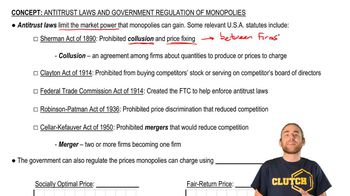
Antitrust laws aim to limit the market power of monopolies and prevent anti-competitive practices such as collusion and price fixing.
진행 상황 추적
컨트롤 버튼이 '내비게이션' 모드로 변경되었습니다.
1/15
관련 플래시카드
추천 영상
Antitrust Laws and Government Regulation of Monopolies definitions
Antitrust Laws and Government Regulation of Monopolies
15 용어
VideoThumbView.guidedCourse
07:21
Monopoly:Socially Optimal Price and Fair-Return Price
4
views
VideoThumbView.guidedCourse
03:58
Antitrust Laws
4
views
이 집합의 용어 (15)
하이드의 정의
What is the main purpose of antitrust laws in the United States?
Antitrust laws aim to limit the market power of monopolies and prevent anti-competitive practices such as collusion and price fixing.
What did the Sherman Act of 1890 prohibit?
The Sherman Act prohibited collusion and price fixing between firms to maintain competition in the market.
What is collusion in the context of monopolies?
Collusion occurs when separate firms work together to set prices or output, reducing competition and increasing their market power.
What restriction did the Clayton Act of 1914 impose?
The Clayton Act prohibited companies from buying stock in their competitors or serving on their competitors' boards of directors.
Which agency enforces antitrust laws in the United States?
The Federal Trade Commission (FTC) is responsible for enforcing antitrust laws.
What did the Robinson-Patman Act of 1936 address?
The Robinson-Patman Act prohibited price discrimination that reduces competition in the market.
What is the main concern with mergers under antitrust laws?
Mergers that substantially reduce competition are prohibited to prevent increased market power and monopolistic behavior.
How can the government directly regulate monopolies besides antitrust laws?
The government can set price ceilings to limit the maximum price a monopoly can charge.
What is a socially optimal price ceiling for a monopoly?
A socially optimal price ceiling is set where price equals marginal cost (P=MC), maximizing efficiency and total surplus.
What is the potential downside of setting a socially optimal price ceiling?
Monopolies may incur losses if the price is below their average total cost, possibly forcing them to exit the market in the long run.
What is a fair return price ceiling for a monopoly?
A fair return price ceiling is set where price equals average total cost (P=ATC), allowing the monopoly to cover its costs without earning profit.
How does a fair return price ceiling affect productive efficiency?
It achieves productive efficiency by producing at the lowest possible cost, but does not maximize allocative efficiency.
What is deadweight loss in the context of monopoly regulation?
Deadweight loss is the loss of potential trades that would have benefited both consumers and producers, often reduced by government regulation.
How do price ceilings impact a monopoly's incentive to minimize costs?
Monopolies may lose the incentive to minimize costs since they can set prices equal to their costs, potentially inflating expenses.
What are the two main government strategies for regulating monopolies?
Governments use antitrust laws to restrict monopolistic actions and price ceilings to control monopoly pricing and output.
 뒤로뒤로
뒤로뒤로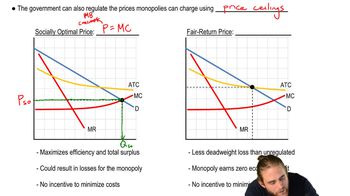
 07:21
07:21