Skip to main content
Microbiology
나의 코스
배우기
시험 준비
AI 튜터
학습 가이드
교과서적 해결책
플래시카드
탐험해 보세요
앱을 사용해 보세요
나의 코스
배우기
시험 준비
AI 튜터
학습 가이드
교과서적 해결책
플래시카드
탐험해 보세요
앱을 사용해 보세요
뒤로
Adaptive Immunity in Microbiology
카드를 뒤집기 위해 탭할 수 있습니다.
What are the two main types of adaptive immunity?
카드를 뒤집기 위해 탭할 수 있습니다.
👆
What are the two main types of adaptive immunity?
Humoral immunity
(antibody-mediated) and
cellular immunity
(cell-mediated).
진행 상황 추적
컨트롤 버튼이 '내비게이션' 모드로 변경되었습니다.
1/25
추천 영상
04:57
Overview of Adaptive Immunity
1806
views
13
rank
04:58
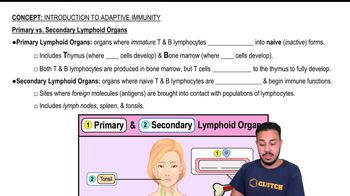
Primary vs. Secondary Lymphoid Organs
2295
views
27
rank
05:47
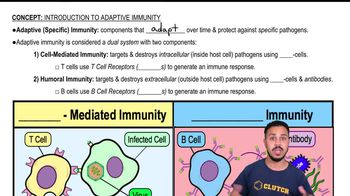
Introduction to Adaptive Immunity
2895
views
48
rank
이 집합의 용어 (25)
하이드의 정의
What are the two main types of adaptive immunity?
Humoral immunity
(antibody-mediated) and
cellular immunity
(cell-mediated).
What cells are involved in humoral immunity?
B cells
that produce antibodies to combat antigens.
Where do B cells mature?
In the
red bone marrow
.
What cells are involved in cellular immunity?
T lymphocytes (T cells)
that recognize antigenic peptides and secrete cytokines.
Where do T cells mature?
In the
thymus
.
What is the role of T cell receptors (TCRs)?
They contact antigens and cause T cells to secrete
cytokines
instead of antibodies.
What types of pathogens does cellular immunity primarily target?
Viruses and
intracellular bacteria
already inside host cells.
What types of pathogens does humoral immunity primarily target?
Extracellular bacteria, toxins, and viruses before they enter host cells.
What are cytokines?
Protein messengers produced by immune cells to communicate and regulate immune responses.
Name four key cytokines and their general functions.
Interleukins
(communication between leukocytes),
Chemokines
(induce leukocyte migration),
Interferons
(interfere with viral infections),
Tumor necrosis factor alpha
(inflammation).
What are antigens?
Substances that cause the production of antibodies, often parts of microbes like capsules or toxins.
What are epitopes?
Specific regions on an antigen where antibodies bind.
What are haptens?
Small molecules that are not antigenic alone but can provoke an immune response when attached to a carrier molecule.
Describe the general structure of an antibody.
Y-shaped protein with two identical light chains and two identical heavy chains joined by disulfide bonds.
What is the valence of an antibody?
The number of antigen-binding sites on the antibody.
Name the five classes of immunoglobulins (Ig).
IgG, IgM, IgA, IgD, and IgE.
What is the main function of IgG?
Most abundant serum antibody; crosses placenta, activates complement, enhances phagocytosis, neutralizes toxins and viruses.
What is unique about IgM?
Pentamer with 10 binding sites; first antibody released in infection; activates complement and causes agglutination.
Where is IgA commonly found and what is its role?
In mucous membranes, saliva, tears, and breast milk; prevents microbial attachment.
What role does IgE play?
Binds to mast cells and basophils; triggers histamine release; important in allergic reactions and defense against parasites.
What are the four types of adaptive immunity based on acquisition?
Naturally acquired active, naturally acquired passive, artificially acquired active, artificially acquired passive.
What is naturally acquired active immunity?
Immunity developed after natural infection with antigen exposure.
What is naturally acquired passive immunity?
Antibodies passed from mother to fetus via placenta or breast milk.
What is artificially acquired active immunity?
Immunity developed after vaccination with antigen.
What is artificially acquired passive immunity?
Injection of preformed antibodies for immediate protection.
 뒤로뒤로
뒤로뒤로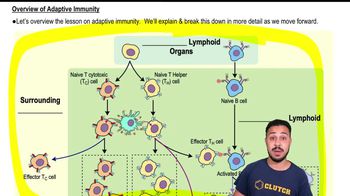
 04:57
04:57