 뒤로
뒤로Ch. 14 PPT Principles of Disease and Epidemiology
 03:25
03:25
이 집합의 용어 (21)
Pathology is the study of disease.
Etiology is the cause of a disease.
Pathogenesis is the manner in which a disease develops.
Infection is the invasion or colonization of the body by pathogens.
Infectious disease occurs when an infection results in any change in the state of health.
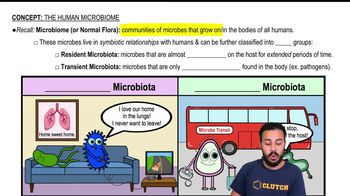
The human microbiome is the community of microorganisms living in and on the human body, beginning to establish in utero and influenced by birth mode and environment.
Normal microbiota permanently colonize the host and do not cause disease under normal conditions.
Microbial antagonism is competition between microbes where normal microbiota protect the host by competing for nutrients and producing harmful substances to pathogens.
Symbiosis is a relationship between organisms; types include commensalism (one benefits, other unaffected), mutualism (both benefit), and parasitism (one benefits at expense of other).
Koch's postulates are criteria to prove the cause of an infectious disease, including isolating the pathogen and reproducing disease in a healthy host.
Exceptions include pathogens causing multiple diseases, only infecting humans, unculturable microbes, and multiple pathogens causing similar symptoms.
Symptoms are subjective changes felt by the patient; signs are objective changes observable or measurable by others.
A communicable disease spreads from one host to another, e.g., influenza or tuberculosis.
Incidence is the number of new cases during a time period; prevalence is the total number of cases at a specific time.
An epidemic disease is acquired by many people in a given area in a short time.
Stages include incubation period, prodromal period, period of illness, period of decline, and period of convalescence.
Reservoirs of infection are continual sources of pathogens, including humans, animals, and nonliving sources like soil and water.
Zoonoses are diseases primarily in animals that can be transmitted to humans.
Direct contact transmission requires close association between infected and susceptible hosts, including congenital transmission.
Vehicle transmission is spread by an inanimate reservoir such as air, water, or food.
Mechanical transmission is when arthropods carry pathogens on feet; biological transmission involves pathogen reproduction in the vector.