 뒤로
뒤로Ch. 18 PPT Vaccines and Immunology in Microbiology
 04:19
04:19
이 집합의 용어 (20)
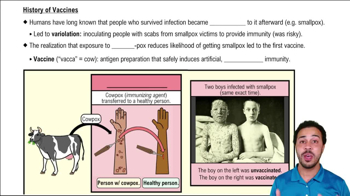
Variolation is a smallpox prevention method involving inoculation of material from dried smallpox scabs into the respiratory tract or skin, used historically in China from the 1400s to 1700s.
Edward Jenner inoculated people with cowpox scab material to prevent smallpox in 1798, and Louis Pasteur later termed this process vaccination from the Latin vacca meaning cow.
A vaccine is a suspension of organisms or fractions of organisms that induce immunity by provoking an immune response.
Vaccines provoke a primary immune response leading to antibody and memory cell formation, and a rapid, intense secondary immune response upon re-exposure.
Herd immunity occurs when most of the population is immune, causing outbreaks to be sporadic due to lack of susceptible individuals.
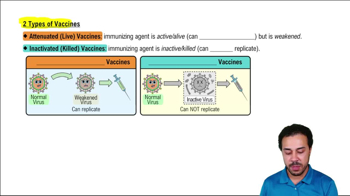
Attenuated vaccines use weakened pathogens that replicate in the body, closely mimicking infection and conferring lifelong immunity but are not given to immunocompromised patients.
Inactivated vaccines contain killed microbes, are safer than attenuated vaccines, require booster doses, and mainly induce humoral immunity.
Subunit vaccines use antigenic fragments like recombinant proteins (e.g., Hepatitis B), toxoids (e.g., diphtheria, tetanus), or virus-like particles (e.g., HPV vaccine).
Polysaccharide vaccines use capsule molecules but are poorly immunogenic; conjugated vaccines attach polysaccharides to proteins to improve immunogenicity in young children.
DNA vaccines inject naked or encapsulated DNA into muscle, directing synthesis of protein antigens that stimulate humoral and cellular immunity.
mRNA vaccines deliver mRNA in lipid nanoparticles to muscle cells, directing synthesis of encoded antigens like the COVID-19 spike protein.
Recombinant vector vaccines use genetically modified avirulent viruses or bacteria to deliver DNA coding for antigens.
Adjuvants like alum and monophosphoryl lipid A enhance vaccine effectiveness by improving innate immune activation through Toll-like receptors.
Vaccines can be administered orally (e.g., rotavirus), nasally (e.g., attenuated influenza), by skin patch, or by injection.
Rarely, vaccines can cause disease (e.g., variolation, oral polio vaccine), but there is no scientific proof linking MMR vaccines to autism; vaccines have an outstanding safety record.
Before the diphtheria vaccine, over 15,000 Americans died in 1921; after vaccination began, only 14 cases were reported since 1996.
Persistence is due to low vaccination rates from poverty, need for boosters, and vaccine avoidance due to safety concerns.
The initiative aims for the elimination of measles and rubella diseases globally.
Polio has been eliminated from most of the world except Afghanistan and Pakistan, with ongoing efforts for full eradication.
The primary response is slower and produces memory cells; the secondary response is faster and stronger due to memory cell activation.