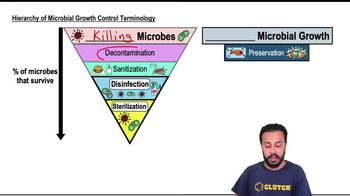
Removal or destruction of all microbial life, including endospores, usually by heat or chemical means.
Define disinfection.
Destruction of most microorganisms and viruses on nonliving tissue.
What is the difference between antisepsis and disinfection?
Antisepsis is the removal of microbes from living tissue, while disinfection is the destruction of microbes on nonliving surfaces.
What factors affect the rate of microbial death?
Number of microbes, environment (organic matter, temperature, biofilms), time of exposure, and microbial characteristics.
How do antimicrobial agents damage microbial cells?
By altering cell walls and membranes, denaturing proteins, and damaging nucleic acids.
What are the goals when selecting microbial control methods?
Agents should be inexpensive, fast-acting, stable during storage, and harmless to humans, animals, and objects.
Which microbes are most resistant to antimicrobial agents?
Prions and bacterial endospores are the most resistant.
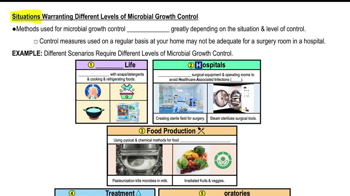
What is the difference between high-level, intermediate-level, and low-level germicides?
High-level kill all pathogens including endospores; intermediate kill fungal spores, protozoan cysts, viruses, and pathogenic bacteria; low-level kill vegetative bacteria, fungi, protozoa, and some viruses.
How does temperature affect antimicrobial efficacy?
Higher temperatures generally increase the efficacy of antimicrobial chemicals and speed microbial death.
 뒤로
뒤로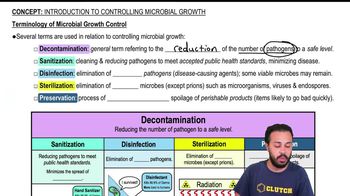
 07:36
07:36