The genome is the entire collection of genetic material in a cell or virus.
Define gene.
A gene is a sequence of DNA that encodes a functional product, such as a protein or RNA.
Difference between genotype and phenotype.
Genotype is the inherited genetic makeup; phenotype is the observable physical and physiological traits.
How is genetic material organized in eukaryotic cells?
Eukaryotic cells have numerous linear chromosomes in the nucleus, organized with histone proteins, plus plasmids and DNA in mitochondria and chloroplasts.
How is genetic material organized in prokaryotic cells?
Prokaryotes have 1-3 usually circular chromosomes in the nucleoid, organized by histone-like proteins, plus plasmids.
What are plasmids?
Plasmids are extra-chromosomal DNA pieces in bacteria and some eukaryotes, often carrying antibiotic resistance genes.
What are the three parts of a nucleotide?
A nucleotide consists of a phosphate group, a sugar (deoxyribose in DNA, ribose in RNA), and a nitrogenous base.
Name the nitrogenous bases and their pairing in DNA.
In DNA, adenine (A) pairs with thymine (T), and guanine (G) pairs with cytosine (C).
Which nitrogenous base replaces thymine in RNA?
Uracil (U) replaces thymine (T) in RNA and pairs with adenine (A).
Describe the structure of DNA.
DNA is a double-stranded antiparallel double helix with complementary base pairs held by hydrogen bonds and a sugar-phosphate backbone.
What is the directionality of DNA strands?
DNA strands have 5’ to 3’ directionality; the two strands run antiparallel (one 5’→3’, the other 3’→5’).
How does RNA structure differ from DNA?
RNA is usually single-stranded, contains ribose sugar, uses uracil instead of thymine, and can form loops and helices.
What is the central dogma of molecular biology?
The central dogma describes genetic information flow: DNA is transcribed into RNA, which is translated into protein.
What is semiconservative DNA replication?
Each new DNA molecule contains one original strand and one newly synthesized strand.
Name the main enzymes involved in DNA replication and their functions.
 뒤로
뒤로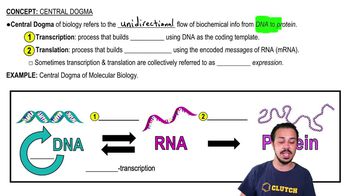
 05:45
05:45