 뒤로
뒤로Microbial Genetics and Microbial Control - Microbiology Study Guide
 02:04
02:04
이 집합의 용어 (28)
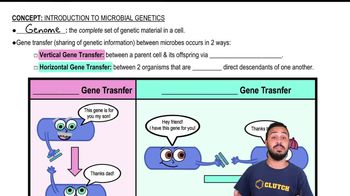
The genome is the complete set of genetic material in an organism, including all of its genes and nucleotide sequences.
A bacterial chromosome is typically a single, circular DNA molecule located in the nucleoid region of the cell, unlike eukaryotic chromosomes which are linear and found in the nucleus.
A plasmid is a small, circular DNA molecule separate from the bacterial chromosome that can replicate independently and often carries genes beneficial for survival.
Types: F plasmids (conjugation), R plasmids (antibiotic resistance), Col plasmids (bacteriocin production), and virulence plasmids (pathogenicity factors).
DNA helicase unwinds the DNA; DNA polymerase III synthesizes new DNA strands; DNA ligase joins Okazaki fragments on the lagging strand.
A pairs with T, and G pairs with C. Given one DNA strand, the complementary strand can be predicted using these rules.
Each new DNA molecule consists of one original (parental) strand and one newly synthesized strand.
Genetic information flows from DNA to RNA to protein, involving the processes of transcription and translation.
Starts with DNA as a template and ends with a single-stranded RNA molecule.
Uracil (U) is used in RNA instead of thymine (T) found in DNA.
Transcription occurs in the cytoplasm of bacterial cells since they lack a nucleus.
RNA polymerase synthesizes RNA by reading the DNA template strand during transcription.
Starts with mRNA and ends with a polypeptide (protein) chain.
A codon is a sequence of three nucleotides on mRNA that codes for an amino acid.
An anticodon is a three-nucleotide sequence on tRNA complementary to the mRNA codon.
The start codon is AUG, which codes for the amino acid methionine.
tRNA delivers specific amino acids to the ribosome by matching its anticodon to the mRNA codon.
rRNA forms the core of the ribosome's structure and catalyzes peptide bond formation.
An operon is a cluster of genes regulated together that controls gene expression in prokaryotes.
Inducible operons are usually off and turned on by a substrate; repressible operons are usually on and turned off by a product.
The lac operon is induced in the presence of lactose and absence of glucose.
The trp operon is repressed when tryptophan levels are high.
A mutation is a change in the nucleotide sequence of DNA.
Point mutations include silent (no amino acid change), missense (different amino acid), and nonsense (stop codon).
Frameshift mutations include insertions and deletions that shift the reading frame.
Transformation (uptake of naked DNA), transduction (DNA transfer by bacteriophages), and conjugation (direct transfer via pili).
An F plasmid carries genes for conjugation; an F+ cell contains the F plasmid and can donate it during conjugation.
Hfr cells have the F plasmid integrated into their chromosome, transferring chromosomal genes during conjugation; recombinant cells are usually F-.