 뒤로
뒤로Microbial Metabolism and Microbial Control
 02:17
02:17
이 집합의 용어 (30)
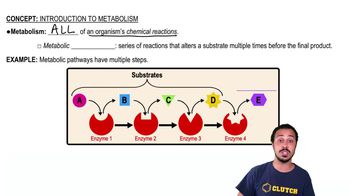
Metabolism encompasses all chemical reactions in a cell that build up and break down nutrients, providing energy and essential substances for life.
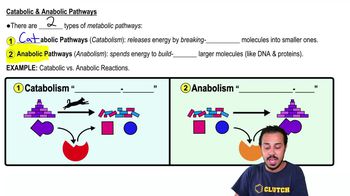
Catabolic reactions break down complex molecules, releasing energy. Anabolic reactions build complex molecules from simpler ones, consuming energy.
ATP stores energy released from catabolic reactions and provides energy for anabolic reactions through hydrolysis and phosphorylation.
Phosphorylation is the transfer of a phosphate group from ATP to another molecule, creating a phosphorylated intermediate that is more reactive.
Enzymes act as biological catalysts that lower activation energy, speeding up reactions without being consumed.
The active site is the region on an enzyme where the substrate binds and the reaction occurs.
Apoenzyme: protein part, inactive alone. Cofactor: nonprotein activator (e.g., metal ions). Coenzyme: organic cofactor (often vitamins). Holoenzyme: apoenzyme plus cofactor, fully active.
Temperature, pH, substrate concentration, and inhibitors affect enzyme activity by altering enzyme structure or substrate binding.
Competitive inhibitors compete with substrate for the active site. Noncompetitive inhibitors bind elsewhere, changing enzyme shape and preventing substrate binding.
Ribozymes are RNA molecules that act as catalysts, facilitating reactions like RNA splicing and protein synthesis.
Redox reactions involve electron transfer; oxidation is loss of electrons, reduction is gain of electrons, releasing energy used to make ATP.
Substrate-level phosphorylation, oxidative phosphorylation (via electron transport chain), and photophosphorylation (in photosynthesis).
Glycolysis, oxidation of pyruvate, Krebs cycle, and electron transport chain.
The Krebs cycle completes pyruvate breakdown, producing ATP, NADH, FADH2, and CO2 as waste.
Aerobic respiration uses oxygen as final electron acceptor, yielding more energy. Anaerobic respiration uses other inorganic molecules, yielding less energy.
Fermentation releases energy from organic molecules without oxygen, using organic molecules as final electron acceptors, producing small ATP amounts.
Proteins are broken into amino acids; lipids into glycerol and fatty acids, which enter glycolysis or Krebs cycle intermediates.
Sterilization is the removal and destruction of all microbial life, including endospores.
Disinfection destroys harmful microorganisms on surfaces; antisepsis destroys harmful microbes on living tissue.
The lowest temperature at which all cells in a liquid culture are killed in 10 minutes.
Uses steam under pressure (121°C, 15 psi, 15 min) to kill all organisms and endospores by denaturing proteins.
Heat treatment (e.g., 72°C for 15 sec) that reduces spoilage organisms and pathogens without sterilizing.
Passage of liquids or gases through filters (e.g., HEPA) to remove microbes, used for heat-sensitive materials.
Low temperatures inhibit microbial growth (bacteriostatic) but do not kill microbes.
Damages DNA by causing lethal mutations using X-rays, gamma rays, or electron beams.
Measures disinfectant effectiveness by exposing microbes to different concentrations and observing survival.
Injure lipids of plasma membranes causing leakage; remain active in presence of organic matter.
Broad-spectrum antimicrobials (e.g., chlorhexidine) used in surgical hand scrubs, effective especially against gram-positive bacteria.
Iodine impairs protein synthesis and alters membranes; chlorine oxidizes and shuts down enzyme systems.
Heavy metals denature proteins at low concentrations, killing microbes (e.g., silver nitrate, mercuric chloride).