Skip to main content
Microbiology
나의 코스
배우기
시험 준비
AI 튜터
학습 가이드
교과서적 해결책
플래시카드
탐험해 보세요
앱을 사용해 보세요
나의 코스
배우기
시험 준비
AI 튜터
학습 가이드
교과서적 해결책
플래시카드
탐험해 보세요
앱을 사용해 보세요
뒤로
Microbiology: Bacterial Structures and Functions
카드를 뒤집기 위해 탭할 수 있습니다.
What is the glycocalyx and where is it located?
카드를 뒤집기 위해 탭할 수 있습니다.
👆
What is the glycocalyx and where is it located?
The
glycocalyx
is a viscous, gelatinous layer external to the cell wall, made of polysaccharides and/or polypeptides.
진행 상황 추적
컨트롤 버튼이 '내비게이션' 모드로 변경되었습니다.
1/13
추천 영상
02:26
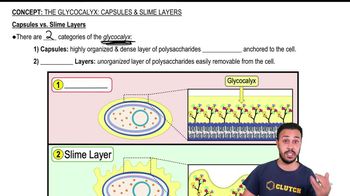
The Glycocalyx: Capsules & Slime Layers
3868
views
43
rank
01:53
Capsules vs. Slime Layers
2783
views
25
rank
이 집합의 용어 (13)
하이드의 정의
What is the glycocalyx and where is it located?
The
glycocalyx
is a viscous, gelatinous layer external to the cell wall, made of polysaccharides and/or polypeptides.
What are the two types of glycocalyx?
The two types of glycocalyx are
capsule
and
slime layer
.
How does the glycocalyx contribute to bacterial virulence?
Capsules prevent phagocytosis and help bacteria adhere to surfaces, increasing virulence.
Name three bacteria that have capsules contributing to virulence.
Bacillus anthracis, Streptococcus pneumoniae, and Klebsiella pneumoniae have capsules that contribute to virulence.
What role does the glycocalyx play in biofilm formation?
The glycocalyx forms biofilms that protect cells and help microbes attach to surfaces.
Give two examples of bacteria that form biofilms using glycocalyx.
Streptococcus mutans and Vibrio cholerae form biofilms using their glycocalyx.
What are bacterial flagella made of and what is their function?
Flagella are filamentous appendages made of the protein
flagellin
that propel bacteria.
What are axial filaments and in which bacteria are they found?
Axial filaments, or endoflagella, are found in spirochetes and cause corkscrew movement by rotating.
Where are axial filaments anchored on the bacterial cell?
Axial filaments are anchored at one end of the cell.
What is the function of fimbriae in bacteria?
Fimbriae are hairlike appendages that enable bacteria to attach to body surfaces.
Name two bacteria that use fimbriae to adhere to host surfaces.
Neisseria gonorrhoeae and E. coli O157 use fimbriae to adhere to host surfaces.
What are pili and what functions do they serve?
Pili are appendages involved in motility (gliding and twitching) and conjugation (DNA transfer).
How do conjugation pili benefit bacteria?
Conjugation pili enable the transfer of genetic material between bacterial cells.
 뒤로뒤로
뒤로뒤로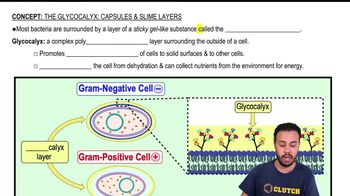
 02:26
02:26