 뒤로
뒤로Microbiology Diagnostic Methods and Immunological Testing
 04:21
04:21
이 집합의 용어 (20)
Sensitivity is the ability of a test to correctly identify those with the disease (true positives).
Specificity is the ability of a test to correctly identify those without the disease (true negatives).
TAT is the time taken from sample collection to the delivery of test results.
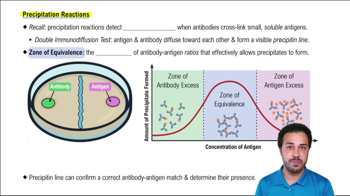
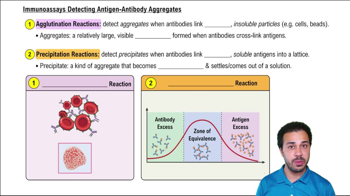
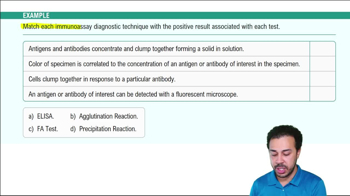
Agglutination tests detect the clumping of particles and are used to identify blood types and detect antibodies or antigens.
PRNT measure the ability of antibodies to neutralize viruses by reducing the number of plaques formed on cell cultures.
PRNT is used to quantify virus-specific neutralizing antibodies, important for vaccine efficacy and infection confirmation.
ELISA detects and quantifies antigens or antibodies using enzyme-linked antibodies and a color change reaction.
ICAs are rapid tests that use antibody-antigen binding on a membrane to produce a visible line, commonly used in point-of-care diagnostics.
IGRA measures interferon gamma released by T-cells in response to Mycobacterium tuberculosis antigens, aiding TB diagnosis.
IGRA provides a more specific and faster alternative to the tuberculin skin test for detecting latent TB infection.
DNA microarrays detect and measure expression of thousands of genes simultaneously to identify pathogens or genetic markers.
Immunological tests are often more specific, sensitive, faster, and can detect immune responses rather than just metabolic products.
Agglutination occurs when antibodies bind to specific blood group antigens, causing visible clumping that identifies blood type.
PCR amplifies specific DNA sequences exponentially, enabling detection of minute amounts of pathogen DNA.
Real-time PCR quantifies DNA during amplification, allowing rapid diagnosis and monitoring of infectious diseases.
RT-PCR converts RNA into DNA before amplification, used to detect RNA viruses like SARS-CoV-2.
Immunological methods detect immune molecules (antibodies/antigens), while biochemical methods detect metabolic products or enzyme activity.
PCR provides high sensitivity and specificity with rapid detection of pathogens, even at low levels.
ICAs use capillary action to move samples across antibody-coated membranes, producing visible lines within minutes.
IGRAs help identify latent TB infections, enabling targeted treatment and reducing disease spread.