Skip to main content
Microbiology
나의 코스
배우기
시험 준비
AI 튜터
학습 가이드
교과서적 해결책
플래시카드
탐험해 보세요
앱을 사용해 보세요
나의 코스
배우기
시험 준비
AI 튜터
학습 가이드
교과서적 해결책
플래시카드
탐험해 보세요
앱을 사용해 보세요
뒤로
Microbiology Key Concepts
카드를 뒤집기 위해 탭할 수 있습니다.
Which scientist established criteria for determining the etiological agent of infectious disease?
카드를 뒤집기 위해 탭할 수 있습니다.
👆
Which scientist established criteria for determining the etiological agent of infectious disease?
Robert Koch established criteria known as Koch's postulates to identify the causative agent of infectious diseases.
진행 상황 추적
컨트롤 버튼이 '내비게이션' 모드로 변경되었습니다.
1/16
추천 영상
01:36
Koch's Postulates
3734
views
52
rank
03:31
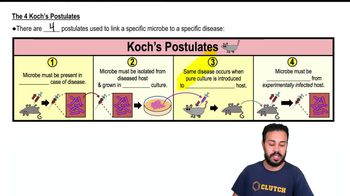
The 4 Koch's Postulates
3697
views
46
rank
02:58
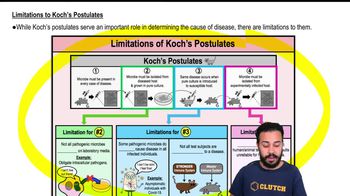
Limitations to Koch's Postulates
2636
views
28
rank
이 집합의 용어 (16)
하이드의 정의
Which scientist established criteria for determining the etiological agent of infectious disease?
Robert Koch established criteria known as Koch's postulates to identify the causative agent of infectious diseases.
What is aseptic technique and why is it central to healthcare?
Aseptic technique involves practices that prevent contamination by pathogens, crucial for reducing infections in healthcare settings.
What is a nosocomial infection?
A nosocomial infection is an infection acquired in a hospital or healthcare facility.
What is the scientific method and its steps?
The scientific method is a systematic process to answer questions: observation, hypothesis, experimentation, analysis, and conclusion.
What does a microbe's morphology describe?
Morphology describes the shape, size, and arrangement of microbial cells.
Name the three domains of life.
The three domains are Bacteria, Archaea, and Eukarya.
What is a strain in microbiology?
A strain is a genetic variant or subtype of a microbial species.
What is binomial nomenclature and who developed it?
Binomial nomenclature is the two-name system for naming species, developed by Carl Linnaeus.
Describe parasitism in symbiotic relationships.
Parasitism is a relationship where one organism benefits at the expense of the other.
Describe mutualism in symbiotic relationships.
Mutualism is a symbiotic relationship where both organisms benefit.
Describe commensalism in symbiotic relationships.
Commensalism is a relationship where one organism benefits and the other is neither helped nor harmed.
What is our normal microbiota?
Normal microbiota are the microorganisms that normally live on and in the human body without causing disease.
What type of symbiotic relationship do we have with our normal microbiota?
We have mostly mutualistic and commensal relationships with our normal microbiota.
What commonly causes disruptions in the normal microbiota?
Antibiotic use is a common cause of disruptions in the normal microbiota.
What is a biofilm? Give an example.
A biofilm is a community of microbes attached to a surface, such as dental plaque on teeth.
What is bioremediation?
Bioremediation is the use of microbes to clean up environmental pollutants.
 뒤로
뒤로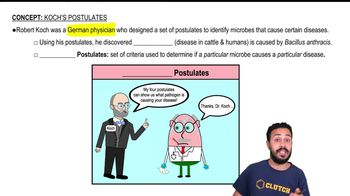
 01:36
01:36