 뒤로
뒤로Microbiology Metabolism and Enzyme Function
 02:17
02:17
이 집합의 용어 (29)
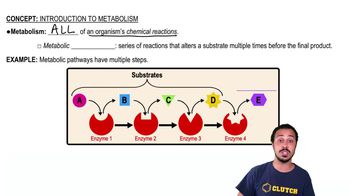
Metabolism refers to all chemical reactions in organisms that break down substances to release energy and reactions that use energy to build new substances.
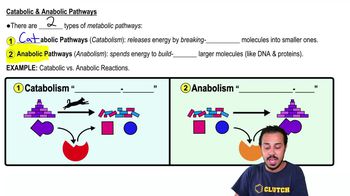
1) Catabolic pathways: break down substances and release energy.
2) Anabolic pathways: use energy to build new molecules.
3) Amphibolic pathways: can function in both breakdown and synthesis.
ATP is made by catabolic reactions and provides energy for anabolic reactions; it consists of adenine, ribose, and three phosphate groups.
Enzymes are protein catalysts that increase reaction rates by lowering activation energy, holding reactants in proper orientation, and are not consumed in reactions.
The active site is the region on an enzyme where the substrate binds and the reaction occurs, following the induced fit model.
Enzymes have optimal temperature and pH; deviations can reduce activity or cause denaturation, which is loss of enzyme structure and function.
Competitive inhibitors slow reactions by competing with the substrate for the enzyme's active site, preventing substrate binding until the inhibitor leaves.
Noncompetitive inhibitors bind to an enzyme at a site other than the active site, decreasing enzyme activity without competing with the substrate.
Cofactors are nonprotein components needed for enzyme function; organic cofactors are called coenzymes, often acting as electron carriers like NAD+ and FAD.
Redox reactions involve oxidation (loss of electrons) and reduction (gain of electrons) occurring together to extract energy from nutrients.
Direct transfer of a high-energy phosphate group from a substrate to ADP to form ATP, occurring in glycolysis and the Krebs cycle.
ATP production using energy from electron transport chains and a proton gradient, primarily during aerobic and anaerobic respiration.
1) Glycolysis
2) Intermediate step (pyruvate oxidation)
3) Krebs cycle
4) Electron transport chain
2 pyruvate, 2 ATP (net gain), and 2 NADH molecules.
Pyruvic acid undergoes decarboxylation to form acetyl-CoA, producing NADH and releasing CO2.
2 ATP (or GTP), 6 NADH, 2 FADH2, and 4 CO2 molecules.
In prokaryotes, it is in the plasma membrane; in eukaryotes, it is in the inner mitochondrial membrane.
The flow of protons down their gradient through ATP synthase, driving the phosphorylation of ADP to ATP.
To regenerate NAD+ from NADH, allowing glycolysis to continue producing ATP when respiratory chains are unavailable.
Homolactic fermentation: produces lactic acid only.
Heterolactic fermentation: produces lactic acid, ethanol, CO2, and other acids.
Exoenzymes such as lipases (lipids), proteases (proteins), and nucleases (nucleic acids) break down macromolecules extracellularly.
Lipases break lipids into glycerol and fatty acids; glycerol enters glycolysis as DHAP, fatty acids undergo beta-oxidation to acetyl-CoA.
Proteases break proteins into amino acids, which can be recycled or deaminated for entry into the Krebs cycle.
The anabolic process of synthesizing glucose from non-sugar precursors using intermediates from glycolysis, Krebs cycle, and catabolism.
Autotrophs make organic carbon from inorganic sources via carbon fixation.
Heterotrophs require external organic carbon sources.
Phototrophs harvest energy from light.
Chemotrophs harvest energy from chemical bonds in nutrients.
When a pathway's end product inhibits an earlier enzyme to slow or stop the pathway, conserving resources.
Obligate anaerobes are harmed by oxygen and use fermentation or anaerobic respiration.
Facultative anaerobes can grow with or without oxygen, using aerobic respiration when oxygen is present.
ATP synthase produces ATP from ADP and inorganic phosphate using energy from protons moving down their electrochemical gradient.