 뒤로
뒤로Microbiology: Virus Structure, Classification, Replication, and Clinical Aspects
 04:47
04:47
이 집합의 용어 (63)
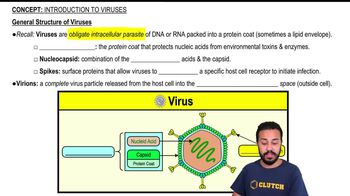
A virus is an obligate intracellular pathogen that requires a host cell to replicate and cannot synthesize its own nucleic acids or proteins independently.
No, viruses cannot synthesize their own nucleic acids or proteins without a host cell.
They must infect and replicate inside a host cell to survive and reproduce.
A bacteriophage or phage.
A virion is a complete, infectious virus particle outside a host cell.
The capsid is the protein coat of a virus, made up of protein subunits called capsomeres.
A capsomere is a protein subunit that assembles to form the viral capsid.
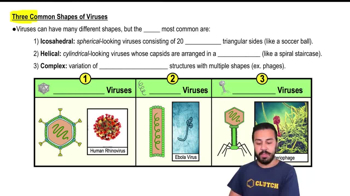
Helical, icosahedral, and complex.
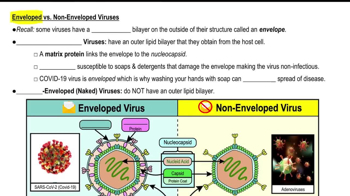
The viral envelope is made of lipids derived from the host cell membrane.
A virus without a lipid envelope, consisting only of a nucleocapsid.
From the host cell membrane during viral budding.
Glycoprotein spikes or peplomers.
Viral spikes are made of glycoproteins.
The viral spikes or attachment proteins bind to specific host cell receptors.
Hemagglutinin (HA) produces H spikes; Neuraminidase (NA) produces N spikes.
No, a virus genome contains either DNA or RNA, but not both.
Single-stranded positive-sense RNA (ssRNA+) genomes function directly as mRNA.
RNA-dependent RNA polymerase synthesizes mRNA from the RNA template.
It converts viral RNA into DNA for integration into the host genome.
RNA polymerases lack proofreading, leading to higher mutation rates.
Generally, no; attenuated strains are weakened and usually do not cause disease in healthy, non-immunocompromised hosts.
Tropism is the specificity of a virus for a particular host cell type or tissue.
Antigenic drift is gradual mutation causing minor changes; antigenic shift is reassortment causing major changes, potentially leading to pandemics.
mRNA vaccine technology encoding the spike protein.
The spike (S) glycoprotein.
A viral vector vaccine using an adenovirus to deliver spike protein DNA.
The spectrum of host species a virus can infect.
They can infect many different cell types or tissues.
False. Viruses are not classified into domains; their highest taxonomic rank is not kingdom or order.
Lytic replication kills the host cell when new phages are released.
A bacteriophage genome integrated into the host bacterial chromosome.
Phage conversion is when a prophage confers new properties to bacteria, such as toxin production.
Attachment, entry, uncoating, replication, assembly, and release.
An infection with rapid onset and short duration.
An infection that lasts for months or years, often with continuous or intermittent symptoms.
Viral DNA integrated into the host genome in animal cells.
An infection where the virus remains dormant in host cells and can reactivate later.
Herpes simplex virus type 1 (HSV-1).
Varicella-zoster virus (VZV) causes chickenpox; reactivation causes shingles.
Viruses that can cause cancer by altering host cell DNA.
Approximately 90% of cervical cancer cases are linked to HPV.
Human T-cell leukemia virus types 1 and 2 (HTLV-1 and HTLV-2).
A clear zone on a bacterial lawn where phages have lysed cells; one plaque represents one infectious virus particle.
Potential allergic reactions in people with egg allergies.
Sensitivity is the ability to detect true positives; specificity is the ability to exclude false positives.
An assay where antibodies or antigens coated on latex beads clump in presence of their specific counterpart.
Enzyme-linked immunosorbent assay (ELISA).
The period after infection before antibodies are detectable in the blood.
PCR amplifies specific DNA sequences; PCR stands for polymerase chain reaction.
Antibiotics target bacterial structures and processes, not viruses.
Drugs target viral components without harming host cells.
RT-PCR tests and antigen rapid detection assays.
RT-PCR detects viral RNA; antigen tests detect viral proteins.
RT-PCR test.
Treatment given after exposure to prevent infection.
Misfolded infectious proteins that cause neurodegenerative diseases.
Misfolded prions induce normal proteins to change shape, propagating disease.
Because they cause sponge-like holes in brain tissue.
Familial Creutzfeldt-Jakob disease and Gerstmann-Sträussler-Scheinker syndrome.
Variant Creutzfeldt-Jakob disease (vCJD).
Spontaneous misfolding of prion proteins without known cause.
Through medical procedures involving contaminated instruments or tissue transplants.
Alzheimer's disease, Parkinson's disease, and Huntington's disease.