Skip to main content
Microbiology
나의 코스
배우기
시험 준비
AI 튜터
학습 가이드
교과서적 해결책
플래시카드
탐험해 보세요
앱을 사용해 보세요
나의 코스
배우기
시험 준비
AI 튜터
학습 가이드
교과서적 해결책
플래시카드
탐험해 보세요
앱을 사용해 보세요
뒤로
Microbiology: Viruses and Prions
카드를 뒤집기 위해 탭할 수 있습니다.
What are viruses?
카드를 뒤집기 위해 탭할 수 있습니다.
👆
What are viruses?
Obligate intracellular parasites
that require a host cell to reproduce; they infect bacteria, protozoa, fungi, algae, plants, and animals.
진행 상황 추적
컨트롤 버튼이 '내비게이션' 모드로 변경되었습니다.
1/20
추천 영상
04:47
General Structure of Viruses
5884
views
171
rank
2
comments
03:19
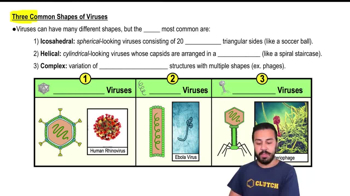
Three Common Shapes of Viruses
4248
views
73
rank
05:09
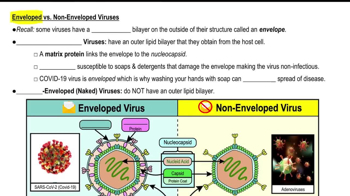
Enveloped vs. Non-Enveloped Viruses
5089
views
98
rank
이 집합의 용어 (20)
하이드의 정의
What are viruses?
Obligate intracellular parasites
that require a host cell to reproduce; they infect bacteria, protozoa, fungi, algae, plants, and animals.
Do viruses fulfill the characteristics of life independently?
No, viruses
do not independently fulfill the characteristics of life
and are not cells.
What is the basic structure of a virus?
A
protein shell (capsid)
surrounding a nucleic acid core, which can be either DNA or RNA, but not both.
What is a nucleocapsid?
The
capsid together with the nucleic acid
inside the virus.
What is the difference between naked and enveloped viruses?
Naked viruses consist only of a nucleocapsid; enveloped viruses have an
external membrane derived from the host cell membrane
.
What are viral spikes and their function?
Protein projections on the virus surface that
allow viruses to dock with host cells
.
What are the two basic viral capsid shapes?
Icosahedral
(20 triangular faces, very stable) and
helical
(rod-shaped, all animal helical viruses are enveloped).
What types of nucleic acids can viruses have?
Viruses can have
single-stranded or double-stranded DNA or RNA
, but never both DNA and RNA simultaneously.
What is a retrovirus?
An RNA virus that carries enzymes to
create DNA from its RNA
for integration into the host genome.
What is the genome size of viruses compared to cells?
Viral genomes are
much smaller
; for example, hepatitis B virus has only four genes.
What is a persistent viral infection?
A state where the virus remains in the host cell without immediate lysis, potentially lasting for the host's life.
What is a chronic latent viral infection?
A viral infection that
periodically reactivates
under stimuli, such as herpes simplex and herpes zoster viruses.
How do viruses contribute to cancer?
Some viruses carry oncogenes or produce proteins that
disrupt growth regulation
, leading to cancer.
Name some oncoviruses and the cancers they cause.
Papillomaviruses (cervical cancer), herpesviruses, hepatitis B virus (liver cancer), and human T-lymphotropic virus (leukemia, lymphoma).
What is a bacteriophage?
A virus that infects bacteria, often making the bacteria more pathogenic to humans.
How are animal viruses cultivated for study?
Using
in vivo
methods (lab animals, embryonic tissues) or
in vitro
cell or tissue cultures.
What are plaques in viral culture?
Clear areas on a cell sheet where virus-infected cells have been destroyed, indicating viral growth.
What are prions?
Infectious proteins with an unclear mode of infection, causing diseases like Creutzfeldt-Jakob and mad cow disease.
Why are antibiotics ineffective against viral infections?
Because antibiotics target bacterial processes, and viruses lack the metabolic machinery targeted by antibiotics.
What is the size range of viruses?
Viruses range from about
20 nm (parvoviruses)
to
150 nm (herpes simplex virus)
and require electron microscopy to be seen.
 뒤로뒤로
뒤로뒤로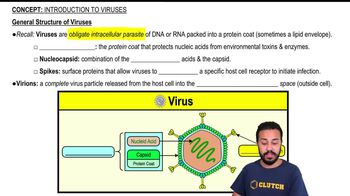
 04:47
04:47