 뒤로
뒤로Slide 9 book
 04:57
04:57
이 집합의 용어 (20)
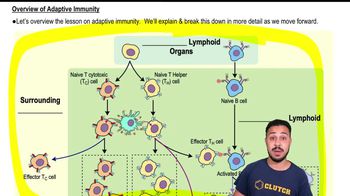
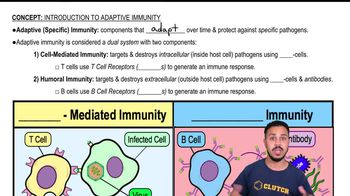
The two main branches are humoral immunity (mediated by B cells and antibodies) and cell-mediated immunity (mediated by T cells).
Adaptive immunity is specific, has memory, and improves with exposure; innate immunity is nonspecific, immediate, and has no memory.
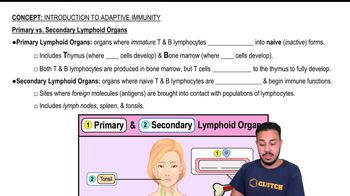
T cells mature in the thymus and mediate cell-mediated immunity; B cells mature in bone marrow and produce antibodies for humoral immunity.
T helper cells assist other immune cells by releasing cytokines; T cytotoxic cells directly kill infected or abnormal cells.
T cells require antigen presentation with MHC plus costimulatory signals for full activation and differentiation.
Cytokine environment and antigen type influence whether T helper cells become Th1, Th2, Th17, or regulatory T cells.
Superantigens bind outside the normal antigen site on MHC and TCR, causing massive, nonspecific T cell activation.
T helper cells activate other immune cells; T cytotoxic cells induce apoptosis in infected or abnormal cells.
Memory T cells persist after initial exposure to provide faster, stronger responses upon re-exposure to the same antigen.
T-dependent antigens require T helper cell help for B cell activation; T-independent antigens activate B cells without T cell help.
Antibodies have two heavy and two light chains forming variable and constant regions; the variable region binds antigen.
Antibodies neutralize pathogens, opsonize for phagocytosis, activate complement, and mediate antibody-dependent cellular cytotoxicity.
Process where B cells change antibody class (e.g., IgM to IgG) without altering antigen specificity, enhancing immune response versatility.
Allows antibodies to acquire different effector functions suited to various stages or types of infection.
IgG (most abundant, crosses placenta), IgA (mucosal immunity), IgM (first produced), IgE (allergy, parasites), IgD (B cell receptor).
Long-lasting immunity due to memory B and T cells that respond faster and stronger upon re-exposure to antigen.
Initial response to antigen with slower antibody production and lower antibody titer.
Faster and stronger antibody production with higher antibody titer due to memory cells.
Measure of antibody concentration in blood, indicating strength of immune response.
Secondary exposure produces a higher and quicker antibody titer compared to the primary response.