The principal short-term energy storage molecule in cells is __________ .
Ch. 2 - The Chemistry of Microbiology
2장, 문제 2
Name five properties of water that are vital to life.
검증된 단계별 안내1
Understand that water's unique properties arise from its molecular structure and hydrogen bonding, which are essential for supporting life processes.
Identify the first property: Cohesion and adhesion, which allow water molecules to stick to each other and to other surfaces, facilitating transport in plants and other organisms.
Recognize the second property: High specific heat capacity, meaning water can absorb or release a large amount of heat with little temperature change, helping to stabilize environmental and cellular temperatures.
Note the third property: High heat of vaporization, which enables cooling through evaporation, such as sweating in animals.
List the fourth and fifth properties: Water is a universal solvent, dissolving many substances necessary for biochemical reactions, and it has a solid form (ice) that is less dense than its liquid form, allowing ice to float and insulate aquatic life in cold environments.

비슷한 문제에 대한 검증된 영상 답변:
이 영상 해법은 위 문제에 도움이 된다고 튜터들이 추천한 것입니다.
영상 길이:
5m주요 개념
질문에 올바르게 답하기 위해 반드시 이해해야 하는 핵심 개념들은 다음과 같습니다.
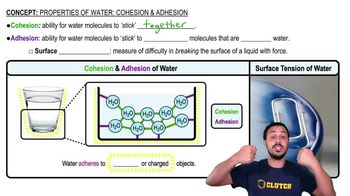
Cohesion and Adhesion
Cohesion refers to water molecules sticking to each other due to hydrogen bonding, enabling surface tension. Adhesion is water's ability to stick to other substances, aiding processes like capillary action in plants.
추천 영상:
Properties of Water- Cohesion and Adhesion
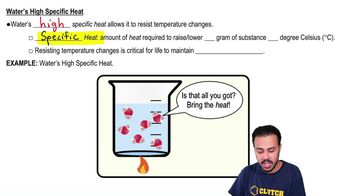
High Specific Heat Capacity
Water can absorb or release large amounts of heat with minimal temperature change, helping organisms and environments maintain stable temperatures essential for life.
추천 영상:
Water’s High Specific Heat
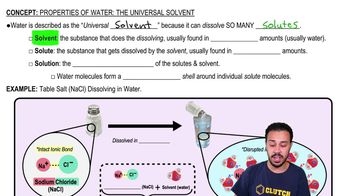
Solvent Properties
Water is a universal solvent because it dissolves many substances, facilitating chemical reactions and transport of nutrients and waste in biological systems.
추천 영상:
Properties of Water- The Universal Solvent
관련 실천
교과서 질문
794
views
교과서 질문
The atomic mass of an atom most closely approximates the sum of the masses of all its __________.
a. protons
b. isotopes
c. electrons
d protons and neutrons
758
views
교과서 질문
One isotope of iodine differs from another in __________ .
a. the number of protons
b. the number of electrons
c. the number of neutrons
d. atomic number
751
views
교과서 질문
The type of chemical bond between atoms with nearly equal electronegativities is called a(n) _____________ bond.
1561
views
교과서 질문
Describe the difference(s) among saturated fatty acids, unsaturated fatty acids, and polyunsaturated fatty acids.
1709
views
교과서 질문
Shown is the amino acid tryptophan. Put the letter “C” at the site of every carbon atom. Label the amino group, the carboxyl group, and the side group.
1480
views