Ch. 21 - Cardiovascular and Lymphatic Infections
Norman-McKay- Microbiology: Basic and Clinical Principles 2nd Edition
Norman-McKay2nd EditionMicrobiology: Basic and Clinical PrinciplesISBN: 9780137661619당신이 사용하는 게 아니라요?교과서 변경
17장, 문제 2

First label the following diseases as bacterial, viral, or protozoan, and then indicate which ones are vectorborne infections: dengue fever, AIDS, chikungunya, Lyme disease, malaria.

검증된 단계별 안내
1
Step 1: Identify the type of pathogen responsible for each disease. Recall that bacterial diseases are caused by bacteria, viral diseases by viruses, and protozoan diseases by protozoa (single-celled eukaryotic organisms).
Step 2: Classify each disease accordingly: - Dengue fever: caused by a virus (Dengue virus). - AIDS: caused by a virus (Human Immunodeficiency Virus, HIV). - Chikungunya: caused by a virus (Chikungunya virus). - Lyme disease: caused by bacteria (Borrelia burgdorferi). - Malaria: caused by protozoa (Plasmodium species).
Step 3: Understand what vectorborne infections are. Vectorborne diseases are transmitted to humans through the bite of infected arthropods such as mosquitoes, ticks, or fleas.
Step 4: Determine which diseases are vectorborne by identifying their vectors: - Dengue fever: transmitted by Aedes mosquitoes (vectorborne). - AIDS: transmitted primarily through bodily fluids, not vectorborne. - Chikungunya: transmitted by Aedes mosquitoes (vectorborne). - Lyme disease: transmitted by ticks (vectorborne). - Malaria: transmitted by Anopheles mosquitoes (vectorborne).
Step 5: Summarize the classification and vectorborne status for each disease to complete the problem.

비슷한 문제에 대한 검증된 영상 답변:

이 영상 해법은 위 문제에 도움이 된다고 튜터들이 추천한 것입니다.
영상 길이:
2m

주요 개념

질문에 올바르게 답하기 위해 반드시 이해해야 하는 핵심 개념들은 다음과 같습니다.

Classification of Infectious Diseases by Pathogen Type

Infectious diseases are categorized based on the type of causative agent: bacteria, viruses, or protozoa. Understanding these categories helps identify the nature of the disease and guides treatment options. For example, bacterial diseases are caused by bacteria, viral diseases by viruses, and protozoan diseases by single-celled eukaryotic organisms.
추천 영상:
05:09
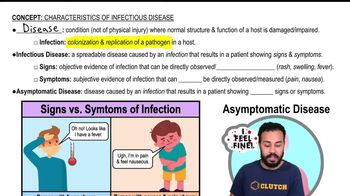
Intro to Characteristics of Infectious Disease

Vectorborne Diseases

Vectorborne diseases are infections transmitted to humans through carriers called vectors, often arthropods like mosquitoes or ticks. Recognizing which diseases are vectorborne is crucial for understanding their transmission dynamics and implementing control measures. Examples include malaria transmitted by mosquitoes and Lyme disease transmitted by ticks.
추천 영상:
04:57
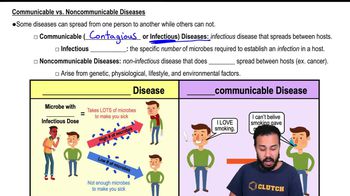
Communicable vs. Noncommunicable Diseases

Examples of Specific Diseases and Their Classification

Familiarity with common diseases and their classifications aids in quick identification. Dengue fever and chikungunya are viral and mosquito-borne; AIDS is viral but not vectorborne; Lyme disease is bacterial and tick-borne; malaria is protozoan and mosquito-borne. This knowledge links disease characteristics to their causative agents and transmission.
추천 영상:
04:57
Communicable vs. Noncommunicable Diseases