Ch. 11 - The Prokaryotes: Domains Bacteria and Archaea
Tortora - Microbiology: An Introduction 14th Edition
Tortora14th EditionMicrobiology: An IntroductionISBN: 9780138200398당신이 사용하는 게 아니라요?교과서 변경
7장, 문제 1

If you Gram-stained the bacteria that live in the human intestine, you would expect to find mostly
a. gram-positive cocci.
b. gram-negative rods.
c. gram-positive, endospore-forming rods.
d. gram-negative, nitrogen-fixing bacteria.
e. all of the above.

검증된 단계별 안내
1
Step 1: Understand the Gram stain and bacterial morphology terms. Gram-positive bacteria retain the crystal violet stain and appear purple, while Gram-negative bacteria do not and appear pink/red. Cocci are spherical bacteria, rods are cylindrical, and endospore-forming rods are a specific group of Gram-positive bacteria capable of forming spores.
Step 2: Recall the typical bacterial composition of the human intestine. The gut microbiota is dominated by certain groups of bacteria, primarily from the phyla Bacteroidetes and Firmicutes.
Step 3: Identify the Gram reaction and shape of the dominant intestinal bacteria. Bacteroidetes are mostly Gram-negative rods, while Firmicutes include many Gram-positive rods and cocci, but many Firmicutes in the gut are not endospore-forming.
Step 4: Evaluate the options given: (a) gram-positive cocci, (b) gram-negative rods, (c) gram-positive, endospore-forming rods, (d) gram-negative, nitrogen-fixing bacteria, and (e) all of the above. Consider which group is most abundant in the human intestine.
Step 5: Conclude that since the majority of gut bacteria are Gram-negative rods (such as Bacteroides species), the best answer corresponds to option (b).

비슷한 문제에 대한 검증된 영상 답변:

이 영상 해법은 위 문제에 도움이 된다고 튜터들이 추천한 것입니다.
영상 길이:
1m

주요 개념

질문에 올바르게 답하기 위해 반드시 이해해야 하는 핵심 개념들은 다음과 같습니다.

Gram Staining and Bacterial Cell Wall Structure

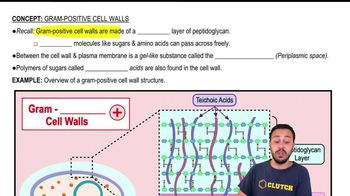
Gram staining differentiates bacteria based on their cell wall composition. Gram-positive bacteria have thick peptidoglycan layers that retain the crystal violet stain, appearing purple, while gram-negative bacteria have thinner peptidoglycan and an outer membrane, appearing pink after counterstaining.
추천 영상:
02:59
Gram-Positive Cell Walls

Common Bacterial Morphologies in the Human Intestine

The human intestine predominantly harbors gram-negative rods, such as Escherichia coli and Bacteroides species. These bacteria play key roles in digestion and maintaining gut health, contrasting with less common gram-positive cocci or endospore-forming rods in this environment.
추천 영상:
02:44
Types of Bacterial Cell Morphology

Role of Nitrogen-Fixing Bacteria and Their Typical Habitats

Nitrogen-fixing bacteria convert atmospheric nitrogen into usable forms but are mostly found in soil or plant root nodules, not the human intestine. Thus, gram-negative nitrogen-fixing bacteria are unlikely to be predominant in the gut microbiota.
추천 영상:
06:18
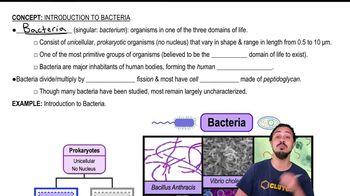
Introduction to Bacteria