
Ch. 14 - Principles of Disease and Epidemiology
Tortora - Microbiology: An Introduction 14th Edition
Tortora14th EditionMicrobiology: An IntroductionISBN: 9780138200398당신이 사용하는 게 아니라요?교과서 변경
10장, 문제 8

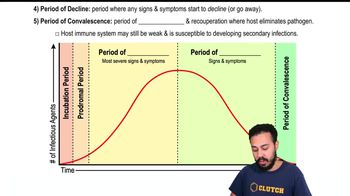
Put the following in the correct order to describe the pattern of disease: period of convalescence, prodromal period, period of decline, incubation period, period of illness.

검증된 단계별 안내
1
Understand that the pattern of disease progression follows a sequence of stages starting from exposure to recovery.
Identify the first stage as the incubation period, which is the time between exposure to the pathogen and the appearance of the first symptoms.
Next is the prodromal period, characterized by the onset of mild or nonspecific symptoms indicating the beginning of illness.
Then comes the period of illness, where the disease is at its peak with the most severe symptoms.
Following this is the period of decline, during which symptoms start to subside and the patient begins to recover.
Finally, the period of convalescence is the stage where the patient regains strength and returns to normal health.

비슷한 문제에 대한 검증된 영상 답변:

이 영상 해법은 위 문제에 도움이 된다고 튜터들이 추천한 것입니다.
영상 길이:
2m

주요 개념

질문에 올바르게 답하기 위해 반드시 이해해야 하는 핵심 개념들은 다음과 같습니다.

Stages of Infectious Disease

The progression of an infectious disease follows distinct stages: incubation, prodromal, illness, decline, and convalescence. Understanding these stages helps in identifying the timeline and symptoms of disease development.
추천 영상:
05:36
Stages of Infectious Disease Progression

Incubation Period

This is the time between exposure to a pathogen and the appearance of the first symptoms. During this period, the pathogen multiplies without causing noticeable symptoms, making it crucial for disease transmission and diagnosis.
추천 영상:
05:36
Stages of Infectious Disease Progression

Prodromal and Illness Periods

The prodromal period is when early, mild symptoms appear, signaling the onset of disease. The illness period follows, characterized by the most severe symptoms and peak pathogen activity, defining the height of the disease.
추천 영상:
05:36
Stages of Infectious Disease Progression
관련 실천
교과서 질문

Use the following information to answer questions 8–10.

A Maryland woman was hospitalized with dehydration. V. cholerae and Plesiomonas shigelloides were isolated from the patient, who had neither traveled outside the United States nor eaten raw shellfish during the preceding month. The patient had attended a party before hospitalization. Two other people at the party had acute diarrheal illness and elevated levels of serum antibodies against Vibrio. Everyone at the party ate crabs and rice pudding with coconut milk. Crabs left over from this party were served at a second party. One of the people at the second party had onset of mild diarrhea; specimens from of these people were negative for vibriocidal antibodies.

The source of the disease was

a. Plesiomonas shigelloides.

b. crabs.

c. V. cholerae.

d. coconut milk.

e. rice.

627
views
교과서 질문

Use the following information to answer questions 6–7.

On September 6, a 6-year-old boy experienced fever, chills, and vomiting. On September 7, the child was hospitalized with diarrhea and swollen lymph nodes under both arms. On September 3, he had been scratched and bitten by a cat. The cat was found dead on September 5, and Y. pestis was isolated from the cat. Chloramphenicol was administered to the child from September 7, when Y. pestis was isolated from his blood. On September 17, the child's temperature returned to normal. On September 22, the child was released from the hospital

Identify the prodromal period for this disease.

a. September 3-5

b. September 3-6

c. September 6-7

d. September 6-17

630
views
교과서 질문

Why are some organisms that constitute the normal microbiota described as commensals, whereas others are described as mutualistic?

1467
views
교과서 질문

Use the following information to answer questions 6–7.

On September 6, a 6-year-old boy experienced fever, chills, and vomiting. On September 7, the child was hospitalized with diarrhea and swollen lymph nodes under both arms. On September 3, he had been scratched and bitten by a cat. The cat was found dead on September 5, and Y. pestis was isolated from the cat. Chloramphenicol was administered to the child from September 7, when Y. pestis was isolated from his blood. On September 17, the child's temperature returned to normal. On September 22, the child was released from the hospital.

Identify the incubation period for this case of bubonic plague.

a. September 3-5

b. September 3-6

c. September 6-7

d. September 6-17

845
views
교과서 질문

Use the following information to answer questions 8–10.

A Maryland woman was hospitalized with dehydration. V. cholerae and Plesiomonas shigelloides were isolated from the patient, who had neither traveled outside the United States nor eaten raw shellfish during the preceding month. The patient had attended a party before hospitalization. Two other people at the party had acute diarrheal illness and elevated levels of serum antibodies against Vibrio. Everyone at the party ate crabs and rice pudding with coconut milk. Crabs left over from this party were served at a second party. One of the people at the second party had onset of mild diarrhea; specimens from of these people were negative for vibriocidal antibodies.

This is an example of

a. vehicle transmission.

b. airborne transmission.

c. transmission by fomites.

d. direct contact transmission.

e. healthcare-associated transmission.

852
views
교과서 질문

This microbe is acquired by humans as infants and is essential for good health. Acquiring a closely related strain causes severe stomach cramps, bloody diarrhea, and vomiting. What is the microbe?

1503
views