Ch. 14 - Principles of Disease and Epidemiology
Tortora - Microbiology: An Introduction 14th Edition
Tortora14th EditionMicrobiology: An IntroductionISBN: 9780138200398당신이 사용하는 게 아니라요?교과서 변경
10장, 문제 5

Which one of the following diseases is not correctly matched to its reservoir?
a. Influenza-animal
b. Rabies-animal
c. Botulism-nonliving
d. Anthrax-nonliving
e. Toxoplasmosis-cats

검증된 단계별 안내
1
Step 1: Understand the concept of a reservoir in infectious diseases. A reservoir is the natural habitat where a pathogen normally lives, grows, and multiplies. It can be living (animals, humans) or nonliving (soil, water).
Step 2: Review each disease and identify its commonly known reservoir: Influenza typically has humans as the main reservoir, although some strains can be found in animals; Rabies is primarily maintained in animal reservoirs; Botulism is caused by Clostridium botulinum, which is found in nonliving reservoirs like soil; Anthrax is caused by Bacillus anthracis, which also persists in nonliving reservoirs such as soil; Toxoplasmosis is caused by Toxoplasma gondii, with cats as the definitive host and reservoir.
Step 3: Compare the given matches to the known reservoirs: (a) influenza-animal, (b) rabies-animal, (c) botulism-nonliving, (d) anthrax-nonliving, (e) toxoplasmosis-cats.
Step 4: Identify which pairing is incorrect by checking if the reservoir listed matches the typical reservoir for that disease. For example, influenza is primarily a human reservoir disease, so 'influenza-animal' may be incorrect.
Step 5: Conclude which option is not correctly matched based on the above analysis.

비슷한 문제에 대한 검증된 영상 답변:

이 영상 해법은 위 문제에 도움이 된다고 튜터들이 추천한 것입니다.
영상 길이:
3m

주요 개념

질문에 올바르게 답하기 위해 반드시 이해해야 하는 핵심 개념들은 다음과 같습니다.

Disease Reservoirs

A disease reservoir is the natural habitat where a pathogen lives, grows, and multiplies. Reservoirs can be living organisms like animals or humans, or nonliving environments such as soil or water. Understanding reservoirs helps identify sources of infection and control disease spread.
추천 영상:
04:57
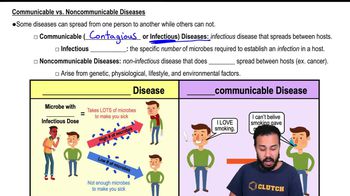
Communicable vs. Noncommunicable Diseases

Zoonotic Diseases

Zoonotic diseases are infections transmitted from animals to humans. Many pathogens have animal reservoirs, such as rabies in mammals or toxoplasmosis in cats. Recognizing zoonotic reservoirs is crucial for preventing cross-species transmission.
추천 영상:
04:57
Communicable vs. Noncommunicable Diseases

Nonliving Reservoirs in Microbial Diseases

Some pathogens persist in nonliving reservoirs like soil, water, or decaying matter. For example, anthrax spores survive in soil, and botulism toxin is produced in improperly stored food. Identifying nonliving reservoirs aids in environmental control measures.
추천 영상:
04:57
Communicable vs. Noncommunicable Diseases
관련 실천
교과서 질문

Distinguish symptoms from signs as signals of disease.

1210
views

교과서 질문

Why are some organisms that constitute the normal microbiota described as commensals, whereas others are described as mutualistic?

1467
views
교과서 질문

Which of the following is not one of Koch's postulates?

a. The same pathogen must be present in every case of the disease.

b. The pathogen must be isolated and grown in pure culture from the diseased host.

c. The pathogen from pure culture must cause the disease when inoculated into a healthy, susceptible laboratory animal.

d. The disease must be transmitted from a diseased animal to a healthy, susceptible animal by direct contact.

e. The pathogen must be isolated in pure culture from an experimentally infected lab animal.

1539
views
교과서 질문

Among hospital patients who have infections, one-third did not enter the hospital with the infection but rather acquired it in the hospital. How do they acquire these infections? What is the method of transmission of these infections? What is the reservoir of infection?

1235
views
교과서 질문

Use the following information to answer questions 6–7.

On September 6, a 6-year-old boy experienced fever, chills, and vomiting. On September 7, the child was hospitalized with diarrhea and swollen lymph nodes under both arms. On September 3, he had been scratched and bitten by a cat. The cat was found dead on September 5, and Y. pestis was isolated from the cat. Chloramphenicol was administered to the child from September 7, when Y. pestis was isolated from his blood. On September 17, the child's temperature returned to normal. On September 22, the child was released from the hospital.

Identify the incubation period for this case of bubonic plague.

a. September 3-5

b. September 3-6

c. September 6-7

d. September 6-17

845
views
교과서 질문

How can a local infection become a systemic infection?

1312
views