Ch. 15 - Microbial Mechanisms of Pathogenicity
Tortora - Microbiology: An Introduction 14th Edition
Tortora14th EditionMicrobiology: An IntroductionISBN: 9780138200398당신이 사용하는 게 아니라요?교과서 변경
11장, 문제 5

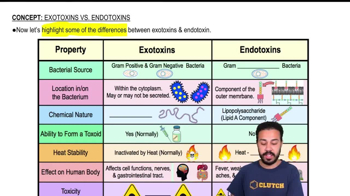
Compare and contrast the following aspects of endotoxins and exotoxins: bacterial source, chemistry, toxigenicity, and pharmacology. Give an example of each toxin.

검증된 단계별 안내
1
Identify the bacterial source of endotoxins and exotoxins: Endotoxins are typically part of the outer membrane of Gram-negative bacteria, whereas exotoxins are secreted by both Gram-positive and Gram-negative bacteria.
Describe the chemical nature of each toxin: Endotoxins are lipopolysaccharides (LPS), specifically the lipid A component, while exotoxins are proteins or polypeptides with enzymatic activity.
Explain toxigenicity differences: Exotoxins are highly potent and specific toxins that can cause disease even in small amounts, whereas endotoxins generally have lower toxicity and cause effects mainly when released in large quantities during bacterial cell lysis.
Discuss pharmacological effects: Exotoxins often have specific targets and mechanisms (e.g., neurotoxins, enterotoxins), leading to distinct clinical syndromes, while endotoxins trigger a generalized immune response, such as fever, inflammation, and septic shock.
Provide examples: For endotoxins, an example is the lipopolysaccharide from Escherichia coli; for exotoxins, examples include the botulinum toxin from Clostridium botulinum or diphtheria toxin from Corynebacterium diphtheriae.

비슷한 문제에 대한 검증된 영상 답변:

이 영상 해법은 위 문제에 도움이 된다고 튜터들이 추천한 것입니다.
영상 길이:
3m

주요 개념

질문에 올바르게 답하기 위해 반드시 이해해야 하는 핵심 개념들은 다음과 같습니다.

Bacterial Source of Endotoxins and Exotoxins

Endotoxins are components of the outer membrane of Gram-negative bacteria, specifically lipopolysaccharides (LPS), released mainly when the bacteria die. Exotoxins are proteins secreted actively by both Gram-positive and Gram-negative bacteria during growth. Understanding the bacterial origin helps differentiate their roles in infection and immune response.
추천 영상:
07:22
Exotoxins vs. Endotoxin Review

Chemistry and Toxigenicity of Endotoxins and Exotoxins

Endotoxins are lipopolysaccharides with relatively stable chemical structures and generally cause fever and inflammation but are less potent. Exotoxins are protein molecules, often enzymes, highly potent and specific in their toxic effects, such as neurotoxins or enterotoxins. Their chemical nature influences their mechanism and intensity of toxicity.
추천 영상:
07:22
Exotoxins vs. Endotoxin Review

Pharmacology and Examples of Endotoxins and Exotoxins

Endotoxins trigger systemic effects like fever and shock by activating immune responses, but they are not neutralized by antitoxins. Exotoxins have specific targets and mechanisms, often neutralized by antitoxins or vaccines. Examples include Lipid A in endotoxins from E. coli and botulinum toxin as an exotoxin from Clostridium botulinum.
추천 영상:
07:22
Exotoxins vs. Endotoxin Review
관련 실천
교과서 질문

Label this diagram to show how the Shiga toxin enters and inhibits protein synthesis in a human cell.

1342
views
1
rank
교과서 질문

Explain how drugs that bind each of the following would affect pathogenicity:

a. Iron in the host's blood

b. N. gonorrhoeae fimbriae

c. S. pyogenes M protein

1259
views
교과서 질문

A drug that binds to mannose on human cells would prevent

a. the entrance of Vibrio enterotoxin.

b. the attachment of pathogenic E. coli.

c. the action of botulinum toxin.

d. streptococcal pneumonia.

e. the action of diphtheria toxin.

1246
views
교과서 질문

Describe how hemolysins, leukocidins, coagulase, kinases, hyaluronidase, siderophores, and IgA proteases might contribute to pathogenicity.

1325
views
교과서 질문

All of the following are related to bacterial infection. Which would prevent all of the others?

a. Vaccination against fimbriae

b. Phagocytosis

c. Inhibition of phagocytic digestion

d. Destruction of adhesins

e. Alteration of cytoskeleton

1499
views
교과서 질문

The ID₅₀ for Campylobacter sp. is 500 cells; the ID₅₀ for Cryptosporidium sp. is 100 cells. Which of the following statements is false?

a. Both microbes are pathogens.

b. Both microbes produce infections in 50% of the inoculated hosts.

c. Campylobacter is more virulent than Cryptosporidium.

d. Campylobacter and Cryptosporidium are equally virulent; they cause infections in the same number of test animals.

e. Cryptosporidium infections are acquired more easily than Campylobacter infections.

1279
views