How can the complement system cause endotoxic shock?
Ch. 16 - Innate Immunity: Nonspecific Defenses of the Host

12장, 문제 3
If the following are placed in the order of occurrence, which would be the third step?
a. Diapedesis
b. Digestion
c. Formation of a phagosome
d. Formation of a phagolysosome
e. Margination
검증된 단계별 안내1
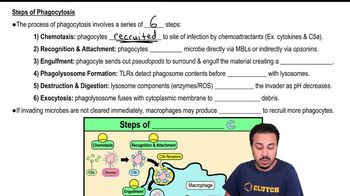
First, understand the sequence of events in the process of phagocytosis, which is how immune cells like neutrophils or macrophages engulf and destroy pathogens.
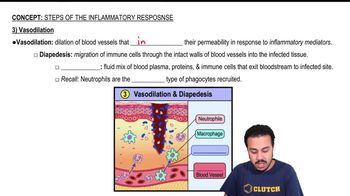
Identify the initial steps where immune cells move toward the site of infection: margination (e) is when leukocytes move to the blood vessel walls, followed by diapedesis (a), where they squeeze through the vessel walls into the tissue.
Next, the immune cells encounter the pathogen and engulf it, leading to the formation of a phagosome (c), which is a vesicle containing the ingested particle.
After the phagosome forms, it fuses with a lysosome to create a phagolysosome (d), where digestive enzymes break down the pathogen.
Finally, digestion (b) occurs inside the phagolysosome, where the pathogen is degraded by enzymes.

비슷한 문제에 대한 검증된 영상 답변:
이 영상 해법은 위 문제에 도움이 된다고 튜터들이 추천한 것입니다.
영상 길이:
1m주요 개념
질문에 올바르게 답하기 위해 반드시 이해해야 하는 핵심 개념들은 다음과 같습니다.
Phagocytosis Process
Phagocytosis is a cellular mechanism where immune cells engulf and destroy pathogens. It involves sequential steps including recognition, attachment, ingestion, and digestion of microbes, essential for innate immunity.
추천 영상:
Steps of Phagocytosis
Diapedesis and Margination
Margination is the process where white blood cells move toward the blood vessel walls, followed by diapedesis, where they squeeze through the vessel walls to reach infection sites. These steps precede phagocytosis.
추천 영상:
3) Vasodilation
Phagosome and Phagolysosome Formation
After engulfing a pathogen, the immune cell forms a phagosome, a vesicle containing the microbe. This then fuses with a lysosome to form a phagolysosome, where digestive enzymes break down the pathogen.
추천 영상:
Formation & Breakdown of Polysaccharides
관련 실천
교과서 질문
1536
views
교과서 질문
If the following are placed in the order of occurrence, which would be the third step?
a. Activation of C5 through C9
b. Cell lysis
c. Antigen–antibody reaction
d. Activation of C3
e. Activation of C2 through C4
801
views
교과서 질문
Patients with X-linked chronic granulomatous disease are susceptible to infections because their neutrophils don’t generate an oxidative burst. What is the relation of the oxidative burst to infection?
1470
views
교과서 질문
Define inflammation, and list its characteristics.
2049
views
교과서 질문
What are interferons? Discuss their roles in innate immunity.
1559
views
교과서 질문
Chlamydia can prevent the formation of phagolysosomes and therefore can
a. avoid being phagocytized.
b. avoid destruction by complement.
c. prevent adherence.
d. avoid being digested.
e. none of the above
1469
views