Ch. 17 - Adaptive Immunity: Specific Defenses of the Host
Tortora - Microbiology: An Introduction 14th Edition
Tortora14th EditionMicrobiology: An IntroductionISBN: 9780138200398당신이 사용하는 게 아니라요?교과서 변경
13장, 문제 4

Match the following choices to questions 1–4:
a. Innate resistance
b. Naturally acquired active immunity
c. Naturally acquired passive immunity
d. Artificially acquired active immunity
e. Artificially acquired passive immunity
A newborn’s immunity to yellow fever.

검증된 단계별 안내
1
Step 1: Understand the types of immunity listed. Innate resistance (a) is the natural, non-specific defense present from birth. Naturally acquired active immunity (b) occurs when a person is exposed to a pathogen and develops their own immune response. Naturally acquired passive immunity (c) involves the transfer of antibodies from mother to child, such as through the placenta or breast milk. Artificially acquired active immunity (d) results from vaccination, where an antigen is introduced to stimulate the immune system. Artificially acquired passive immunity (e) involves the injection of antibodies from an external source, such as antiserum.
Step 2: Analyze the scenario: 'A newborn’s immunity to yellow fever.' Since the newborn has not been vaccinated or exposed to yellow fever, active immunity (either natural or artificial) is unlikely.
Step 3: Consider how the newborn could have immunity. The newborn may have received antibodies from the mother through the placenta during pregnancy or through breast milk after birth, which is a form of passive immunity.
Step 4: Determine whether this passive immunity is naturally or artificially acquired. Since the antibodies come from the mother naturally, this is naturally acquired passive immunity.
Step 5: Match the scenario to the correct choice: 'A newborn’s immunity to yellow fever' corresponds to choice (c) naturally acquired passive immunity.

비슷한 문제에 대한 검증된 영상 답변:

이 영상 해법은 위 문제에 도움이 된다고 튜터들이 추천한 것입니다.
영상 길이:
4m

주요 개념

질문에 올바르게 답하기 위해 반드시 이해해야 하는 핵심 개념들은 다음과 같습니다.

Innate Resistance

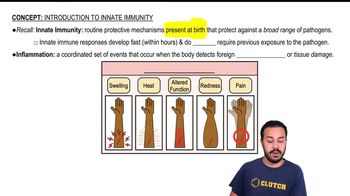
Innate resistance refers to the natural, non-specific defense mechanisms present from birth that protect an organism against pathogens. It includes physical barriers like skin and mucous membranes, as well as cellular defenses such as phagocytes. This type of immunity does not require prior exposure to a pathogen.
추천 영상:
02:30
Introduction to Innate Immunity

Naturally Acquired Passive Immunity

Naturally acquired passive immunity occurs when antibodies are transferred from mother to child, typically through the placenta during pregnancy or via breast milk. This provides immediate but temporary protection to the newborn without the infant’s immune system actively producing antibodies.
추천 영상:
06:53
Natural Killer Cells

Active vs Passive Immunity

Active immunity involves the body’s own immune response to produce antibodies after exposure to an antigen, either naturally or through vaccination. Passive immunity, in contrast, is the direct transfer of antibodies from another source, providing immediate but short-lived protection without immune memory.
추천 영상:
05:05
Passive vs. Active Transport