Ch. 24 - Microbial Diseases of the Respiratory System
Tortora - Microbiology: An Introduction 14th Edition
Tortora14th EditionMicrobiology: An IntroductionISBN: 9780138200398당신이 사용하는 게 아니라요?교과서 변경
20장, 문제 10

Match the following choices to the statement in the question given below:
a. Bordetella pertussis
b. Corynebacterium diphtheriae
c. Legionella pneumophila
d. Mycobacterium tuberculosis
e. None of the above
Resistant to destruction by phagocytes.

검증된 단계별 안내
1
Step 1: Understand the key characteristic in the question, which is 'resistant to destruction by phagocytes.' This means the bacterium can survive and multiply inside phagocytic cells, evading the host immune response.
Step 2: Review the properties of each bacterium listed: a) Bordetella pertussis, b) Corynebacterium diphtheriae, c) Legionella pneumophila, d) Mycobacterium tuberculosis, and e) none of the above.
Step 3: Recall that Mycobacterium tuberculosis is well-known for its ability to resist destruction by phagocytes due to its unique cell wall components like mycolic acid, which protect it from lysosomal enzymes.
Step 4: Compare the other bacteria: Bordetella pertussis causes whooping cough but is not primarily known for intracellular survival; Corynebacterium diphtheriae produces a toxin but does not survive inside phagocytes; Legionella pneumophila can survive inside macrophages but is less classically associated with this trait than M. tuberculosis.
Step 5: Based on this analysis, match the statement 'Resistant to destruction by phagocytes' to the bacterium that best fits this characteristic, which is Mycobacterium tuberculosis (d).

비슷한 문제에 대한 검증된 영상 답변:

이 영상 해법은 위 문제에 도움이 된다고 튜터들이 추천한 것입니다.
영상 길이:
3m

주요 개념

질문에 올바르게 답하기 위해 반드시 이해해야 하는 핵심 개념들은 다음과 같습니다.

Phagocytosis and Microbial Evasion

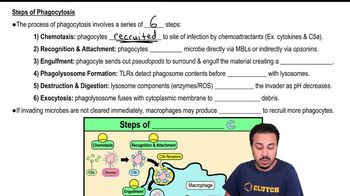
Phagocytosis is a process where immune cells engulf and destroy pathogens. Some bacteria have evolved mechanisms to resist or survive phagocytic destruction, allowing them to persist and cause disease. Understanding these evasion strategies is key to identifying pathogens resistant to phagocytes.
추천 영상:
08:57
Steps of Phagocytosis

Characteristics of Mycobacterium tuberculosis

Mycobacterium tuberculosis is known for its waxy, lipid-rich cell wall containing mycolic acids, which makes it resistant to phagocytic killing. It can survive inside macrophages by inhibiting phagosome-lysosome fusion, enabling it to evade the immune response and cause tuberculosis.
추천 영상:
05:09
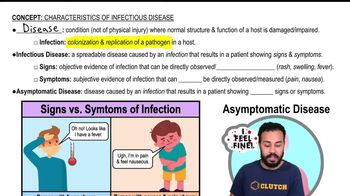
Intro to Characteristics of Infectious Disease

Differentiating Pathogenic Bacteria by Virulence Factors

Different bacteria possess unique virulence factors that determine their interaction with host defenses. For example, Bordetella pertussis produces toxins affecting respiratory cells, while Corynebacterium diphtheriae produces diphtheria toxin. Recognizing these factors helps match bacteria to their pathogenic traits, such as resistance to phagocytosis.
추천 영상:
04:07
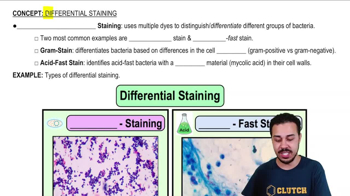
Differential Staining