Ch. 26 - Microbial Diseases of the Urinary and Reproductive Systems
Tortora - Microbiology: An Introduction 14th Edition
Tortora14th EditionMicrobiology: An IntroductionISBN: 9780138200398당신이 사용하는 게 아니라요?교과서 변경
22장, 문제 3

Use the following choices to answer questions 2–5:
a. Candida
b. Chlamydia
c. Gardnerella
d. Neisseria
e. Trichomonas
Microscopic examination of vaginal smear shows ovoid eukaryotic cell.

검증된 단계별 안내
1
Step 1: Identify the key characteristic described in the problem: an ovoid eukaryotic cell observed in a vaginal smear under the microscope.
Step 2: Recall that eukaryotic cells have a defined nucleus and organelles, distinguishing them from prokaryotic cells (bacteria) and viruses.
Step 3: Review the options and classify them as eukaryotic or prokaryotic: Candida (a fungus, eukaryotic), Chlamydia (bacteria, prokaryotic), Gardnerella (bacteria, prokaryotic), Neisseria (bacteria, prokaryotic), Trichomonas (protozoan parasite, eukaryotic).
Step 4: Since the cell is described as ovoid and eukaryotic, focus on Candida and Trichomonas, both eukaryotes, and consider their typical morphology and presence in vaginal smears.
Step 5: Use knowledge of morphology: Candida appears as budding yeast cells (ovoid shape), while Trichomonas is a motile protozoan with flagella, often pear-shaped rather than ovoid. Therefore, the ovoid eukaryotic cell likely corresponds to Candida.

비슷한 문제에 대한 검증된 영상 답변:

이 영상 해법은 위 문제에 도움이 된다고 튜터들이 추천한 것입니다.

주요 개념

질문에 올바르게 답하기 위해 반드시 이해해야 하는 핵심 개념들은 다음과 같습니다.

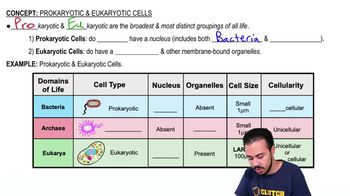
Eukaryotic vs Prokaryotic Cells

Eukaryotic cells have a defined nucleus and membrane-bound organelles, unlike prokaryotic cells which lack these features. Identifying a cell as eukaryotic helps narrow down the type of microorganism, such as fungi or protozoa, rather than bacteria.
추천 영상:
05:54
Prokaryotic & Eukaryotic Cells

Morphology of Vaginal Microorganisms

Understanding the shape and structure of microorganisms found in vaginal smears is crucial. For example, Candida appears as oval yeast cells, Trichomonas is a motile protozoan, and bacteria like Neisseria are diplococci. Morphology aids in distinguishing among possible pathogens.
추천 영상:
01:25
Importance of Microorganisms

Common Vaginal Pathogens

Familiarity with common vaginal pathogens such as Candida (yeast), Trichomonas (protozoan), Gardnerella (bacteria), Neisseria (bacteria), and Chlamydia (bacteria) is essential. Knowing their cellular characteristics helps interpret microscopic findings and select the correct organism.
추천 영상:
03:40
Introduction to Pathogenic Toxins