 뒤로
exam 2.2
 14:23

이 집합의 용어 (25)
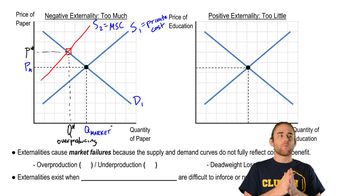
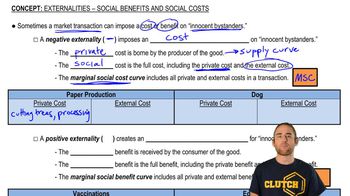
A negative externality exists if the marginal social cost of producing a good exceeds the private cost.
A positive externality occurs when the marginal social benefit exceeds the marginal private benefit of the last unit produced.
A Pigovian tax equal to the difference between the social cost and private cost curves (\(P_2 - P_0\)) corrects overproduction caused by negative externalities.
There are no positive or negative externalities from consumption and production, ensuring economic efficiency.
People not directly involved in producing or paying for a good benefit from a positive externality.
A negative externality exists when social cost is greater than private cost.
A positive externality exists when marginal social benefit exceeds marginal private benefit.
Quasi-public goods are nonrivalrous and excludable.
Private goods are rivalrous and excludable.
Free riding occurs when individuals benefit from a good without paying for it, such as parents not immunizing children but benefiting from others who do.
Price elasticity = percentage change in quantity demanded divided by percentage change in price, calculated using midpoints of price and quantity.
Demand is relatively inelastic if quantity demanded falls by a smaller percentage than the price increase.
If demand is elastic, raising price causes total revenue to fall.
Total revenue is greatest where demand is unit elastic.
Each additional unit consumed provides less satisfaction than the previous one.
Consumers maximize utility when the marginal utility per dollar is equal across all goods.
Marginal utility is the extra satisfaction from consuming one more unit of a good.
Total spending must equal the consumer's budget constraint.
The consumer's optimal bundle shifts to a new point reflecting the higher Pilates price and unchanged budget.
Average fixed cost = fixed cost divided by new output quantity; fixed cost = total cost - variable cost.
Average fixed cost falls as output rises because fixed costs are spread over more units.
Marginal product = change in output = 20 - 18 = 2 chairs.
Average product = total output / number of workers = 54 / 5 = 10.8 pounds.
Private cost is the cost borne directly by the producer in making a good or service.
Excludability means that non-payers can be prevented from consuming the good.