Skip to main content
Microeconomics
나의 코스
배우기
시험 준비
AI 튜터
학습 가이드
플래시카드
탐험해 보세요
앱을 사용해 보세요
나의 코스
배우기
시험 준비
AI 튜터
학습 가이드
플래시카드
탐험해 보세요
앱을 사용해 보세요
뒤로
Microeconomics Exam II Study Guide
카드를 뒤집기 위해 탭할 수 있습니다.
What is a budget constraint?
카드를 뒤집기 위해 탭할 수 있습니다.
👆
What is a budget constraint?
A budget constraint shows all combinations of goods a consumer can buy given their income and prices.
진행 상황 추적
컨트롤 버튼이 '내비게이션' 모드로 변경되었습니다.
1/30
추천 영상
VideoThumbView.guidedCourse
08:41
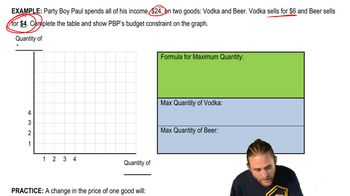
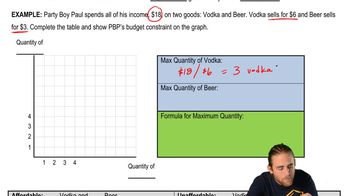
Budget Constraint (Budget Line)
3995
views
69
rank
VideoThumbView.guidedCourse
03:50
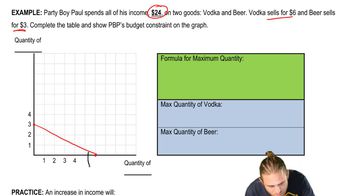
Budget Constraint:Change in Price of a Good
2335
views
23
rank
VideoThumbView.guidedCourse
03:44
Budget Constraint:Change in Income
2286
views
32
rank
이 집합의 용어 (30)
하이드의 정의
What is a budget constraint?
A budget constraint shows all combinations of goods a consumer can buy given their income and prices.
How do you find the intercepts of a budget constraint?
Intercepts are found by dividing income by the price of each good, showing maximum quantity if all income is spent on one good.
What does the slope of the budget constraint represent?
The slope represents the relative price ratio of the two goods, showing the trade-off rate between them.
What is utility?
Utility is a measure of satisfaction or happiness a consumer gets from consuming goods or services.
What is marginal utility?
Marginal utility is the additional satisfaction gained from consuming one more unit of a good.
What is the Law of Diminishing Marginal Utility?
It states that as consumption of a good increases, marginal utility from each additional unit decreases.
What is the household's main objective function?
The household aims to maximize total utility subject to their budget constraint.
What is the Utility Maximization Rule?
Consumers maximize utility by allocating spending so that the marginal utility per dollar is equal across all goods.
If marginal utility per dollar spent on good X is greater than on good Y, what should the consumer do?
The consumer should buy more of good X and less of good Y to increase total utility.
How does the income effect work with normal goods?
When income rises, demand for normal goods increases due to higher purchasing power.
How does the income effect work with inferior goods?
When income rises, demand for inferior goods decreases as consumers buy higher-quality substitutes.
What is the substitution effect?
The substitution effect is the change in consumption caused by a change in relative prices, holding utility constant.
Why do demand curves slope downward?
Because of the substitution and income effects, lower prices increase quantity demanded.
What is the Work-Leisure model?
A model showing how consumers allocate time between labor (work) and leisure to maximize utility.
How do wage changes affect labor supply in the Work-Leisure model?
Wage changes cause substitution and income effects that can increase or decrease labor supply.
What is the difference between accounting costs and economic costs?
Accounting costs are explicit expenses; economic costs include accounting costs plus opportunity costs.
What does a positive economic profit mean?
It means total revenue exceeds all explicit and implicit costs, indicating above-normal returns.
What is the difference between the short-run and long-run in production?
Short-run has at least one fixed input; long-run all inputs are variable.
What is marginal product of labor (MPL)?
MPL is the additional output produced by one more unit of labor.
What does the Law of Diminishing Returns state?
Adding more of one input, holding others fixed, eventually causes marginal product to decline.
What are Total Variable Cost (TVC) and Total Fixed Cost (TFC)?
TVC changes with output; TFC remains constant regardless of output.
What is Marginal Cost (MC)?
MC is the additional cost of producing one more unit of output.
What is the relationship between MPL and MC?
MC decreases when MPL increases and vice versa; they are inversely related.
What are the three characteristics of Perfect Competition?
Many firms, identical products, and free entry and exit.
Why is market price the individual firm's demand curve in perfect competition?
Because firms are price takers and can sell any quantity at the market price.
Where do firms produce to maximize profit?
At output where marginal cost equals marginal revenue (MC = MR).
When should a firm shut down in the short run?
If price is below average variable cost (P < AVC), the firm should shut down.
What is the Long-Run Average Cost (LRAC) curve?
LRAC shows the lowest possible cost per unit when all inputs are variable.
What are Economies of Scale?
Cost advantages from increasing production scale, causing LRAC to fall.
What is the Minimum Efficient Scale (MES)?
The smallest output level where long-run average costs are minimized.
 뒤로뒤로
 08:41