뒤로

Microeconomics: Government Actions in Markets CH 6

컨트롤 버튼이 '내비게이션' 모드로 변경되었습니다.
1/24
  • What is a price ceiling and what happens when it is set below equilibrium in a housing market?

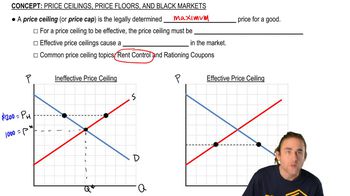
    A price ceiling is a regulation making it illegal to charge above a set price. When set below equilibrium rent (called a rent ceiling), it causes a housing shortage, increased search activity, and illegal trading.
  • What is the effect of a rent ceiling set above the equilibrium rent?

    If the rent ceiling is set above the equilibrium rent, it has no effect and the market operates as if there were no ceiling.
  • What is search activity in the context of a rent ceiling?

    Search activity is the time spent looking for someone to do business with. It increases when a rent ceiling causes a housing shortage, adding to the opportunity cost of housing.
  • How does illegal trading arise under a rent ceiling?

    Illegal trading occurs when renters pay rents above the legal ceiling due to housing shortages, creating a black market with rents often higher than the unregulated market.
  • What inefficiencies does a rent ceiling below equilibrium cause?

    It leads to underproduction of housing, a deadweight loss, reduced consumer and producer surplus, and potential losses from increased search activity.
  • How is scarce housing allocated under a rent ceiling?

    Scarce housing is allocated by lottery, first-come first-served, or discrimination, none of which guarantee a fair outcome.
  • What is a price floor and how does it apply to labor markets?

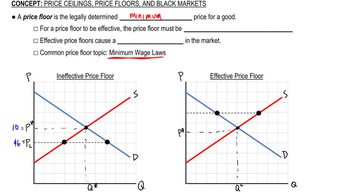
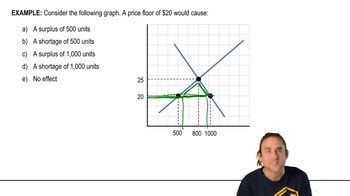
    A price floor is a regulation making it illegal to trade below a set price. In labor markets, this is called a minimum wage.
  • What happens when the minimum wage is set above the equilibrium wage?

    It creates a surplus of labor where quantity supplied exceeds quantity demanded, causing unemployment.
  • Why do most economists believe minimum wage laws increase unemployment for low-skilled workers?

    Because a minimum wage above equilibrium reduces the quantity of labor hired, leading to fewer jobs available for low-skilled younger workers.
  • What inefficiencies arise from a minimum wage set above equilibrium?

    It causes inefficient labor market outcomes with deadweight loss, reduced worker and firm surplus, and increased job search costs.
  • What is tax incidence?

    Tax incidence is the division of the burden of a tax between buyers and sellers, which depends on how the tax affects market prices.
  • Does it matter whether a tax is imposed on buyers or sellers?

    No, the economic effect of a tax is the same regardless of whether it is imposed on buyers or sellers.
  • How does a tax affect supply and demand curves?

    A tax on sellers shifts the supply curve left (up), while a tax on buyers shifts the demand curve left (down), reducing quantity and changing prices.
  • What is the 'tax wedge'?

    The tax wedge is the difference between the price buyers pay and the price sellers receive after a tax is imposed.
  • How does a tax create inefficiency in a market?

    A tax reduces the quantity traded below the efficient level, causing a deadweight loss where marginal social benefit exceeds marginal social cost.
  • How does the elasticity of demand affect tax incidence?

    The more inelastic the demand, the larger the share of the tax paid by buyers; perfectly inelastic demand means buyers pay the entire tax.
  • How does the elasticity of supply affect tax incidence?

    The more inelastic the supply, the larger the share of the tax paid by sellers; perfectly inelastic supply means sellers pay the entire tax.
  • What are production quotas and subsidies in farm product markets?

    A production quota limits the quantity produced; a subsidy is a government payment to producers to encourage production.
  • What inefficiencies do production quotas cause?

    Quotas cause inefficient production where marginal social cost exceeds marginal social benefit, leading to higher prices and incentives to cheat.
  • What inefficiencies do subsidies cause?

    Subsidies cause overproduction where marginal social cost exceeds marginal social benefit, lowering market prices but increasing quantity produced inefficiently.
  • How do markets for illegal goods function?

    Illegal goods markets exist despite prohibition; penalties on buyers or sellers reduce demand or supply, raising prices and lowering quantities traded.
  • What happens when both buyers and sellers are penalized in illegal goods markets?

    Both demand and supply decrease, reducing quantity traded and changing prices; buyers pay more and sellers receive less than the market price.
  • How can illegal goods be regulated alternatively?

    Illegal goods can be legalized and taxed, with a high enough tax reducing consumption similarly to prohibition but with government revenue.
  • What are the two principles of tax fairness?

    The benefits principle states people pay taxes equal to benefits received; the ability-to-pay principle states taxes should be based on taxpayers' ability to bear the burden.