Skip to main content
Microeconomics
나의 코스
배우기
시험 준비
AI 튜터
학습 가이드
플래시카드
탐험해 보세요
앱을 사용해 보세요
나의 코스
배우기
시험 준비
AI 튜터
학습 가이드
플래시카드
탐험해 보세요
앱을 사용해 보세요
뒤로
Microeconomics: Taxes and Tax Incidence
카드를 뒤집기 위해 탭할 수 있습니다.
Why do governments levy taxes?
카드를 뒤집기 위해 탭할 수 있습니다.
👆
Why do governments levy taxes?
Governments levy taxes to fund public services.
진행 상황 추적
컨트롤 버튼이 '내비게이션' 모드로 변경되었습니다.
1/20
추천 영상
VideoThumbView.guidedCourse
03:21
Tax Incidence
3614
views
31
rank
VideoThumbView.guidedCourse
13:27
Taxes and Tax Incidence
5372
views
63
rank
이 집합의 용어 (20)
하이드의 정의
Why do governments levy taxes?
Governments levy taxes to fund public services.
What is a per-unit tax?
A per-unit tax is charged on each unit traded, creating a price gap between buyers and sellers.
What is the tax wedge in a market with a per-unit tax?
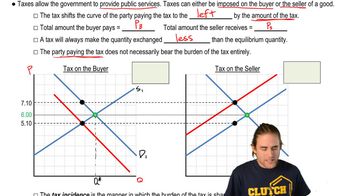
The tax wedge is the difference between the price paid by buyers and the price received by sellers: \(\text{tax}=P_b-P_s\).
How does a per-unit tax affect market prices?
It creates two prices:
price to buyers
(\(P_b\)) and
price to sellers
(\(P_s\)), separated by the tax wedge.
What happens to supply or demand when a tax is imposed on sellers?
The supply curve shifts left by the amount of the tax.
What happens to supply or demand when a tax is imposed on buyers?
The demand curve shifts left by the amount of the tax.
Does it matter who is legally responsible for paying the tax?
No, the market ends up with the same prices and quantity traded regardless of who is legally taxed.
How does a tax affect the quantity traded in the market?
The quantity traded falls: \(Q_T < Q^*\), reducing mutually beneficial trades.
What is tax incidence?
Tax incidence is how the tax burden is split between consumers and producers after market adjustments.
How do you calculate the consumer's tax burden per unit?
Consumer burden = \(P_b - P^*\), the increase in price paid by buyers compared to the original price.
How do you calculate the producer's tax burden per unit?
Producer burden = \(P^* - P_s\), the decrease in price received by sellers compared to the original price.
How do consumer and producer burdens relate to the total tax?
The sum of consumer and producer burdens equals the tax: \((P_b - P^*) + (P^* - P_s) = P_b - P_s = \text{tax}\).
Example: If original price is \$6, tax is \$2, and after-tax prices are \$7.10 (buyers) and \$5.10 (sellers), what is the consumer incidence?
Consumer incidence = \$7.10 - \$6 = \$1.10 per unit.
Example: Using the same data, what is the producer incidence?
Producer incidence = \$6 - \$5.10 = \$0.90 per unit.
In the example, what percent of the tax do consumers bear?
Consumers bear 55% of the tax: \(\frac{1.10}{2} = 55\%\).
In the example, what percent of the tax do producers bear?
Producers bear 45% of the tax: \(\frac{0.90}{2} = 45\%\).
What is the key takeaway about taxes and market efficiency?
Taxes reduce quantity traded and create inefficiency known as deadweight loss.
What does a tax wedge represent in terms of market prices?
It represents the difference between what buyers pay and what sellers receive after tax.
How does the market adjust when a tax is imposed on buyers versus sellers?
The demand curve shifts left if tax is on buyers; the supply curve shifts left if tax is on sellers, but final prices and quantity are the same.
Why is tax incidence important for understanding tax effects?
Because it shows who actually bears the economic burden of the tax, regardless of legal responsibility.
 뒤로뒤로
 03:21