What is the main idea of rational consumer theory?
People's consumer choices are intentional and limited by budget constraints.
What did Pareto (1891) contribute to consumer theory?
He stated that we cannot measure minds but can measure choices, which show predictable patterns.
What is Samuelson's (1938) key insight about consumer choice?
Choice reveals preference and rationality is consistent preferences.
What are the assumptions in consumer theory overview?
Consumers are price takers, have a budget to spend on different goods, have consistent preferences, and choose affordable bundles that maximize preferences.
How is a budget constraint expressed mathematically?
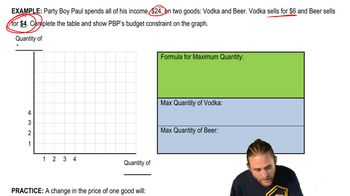
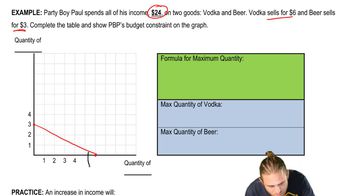
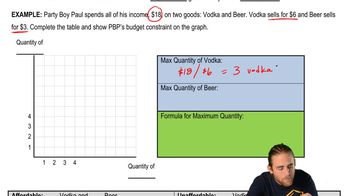
Expenditure equals the sum of price times quantity for each good and cannot exceed available funds, e.g., \(\(5Q_M + 10Q_S \leq 100\)\).
What does the budget line represent?
The budget line describes maximal consumption where expenditure equals available funds, e.g., \(\(5Q_M + 10Q_S = 100\)\).
What is the slope of the budget line and what does it represent?
Slope = −relative price = −\(\(\frac{P_M}{P_S}\)\), showing the trade-off rate between goods.
How does a change in income affect the budget line?
Changes in income cause a parallel shift of the budget line.
How does a change in price affect the budget line?
Changes in price cause a rotation of the budget line.
What is an indifference curve?
A curve showing combinations of goods that the consumer considers equally good.
What does an indifference curve divide?
It divides preferred bundles from less preferred bundles.
What is the marginal rate of substitution (MRS)?
The rate at which a person will give up one good for another while remaining indifferent; related to the slope of the indifference curve.
What does diminishing marginal rate of substitution imply?
Indifference curves get flatter as you move down, reflecting decreasing marginal benefits and preference for variety.
What are perfect substitutes and perfect complements?
Perfect substitutes can replace each other at a constant rate; perfect complements are consumed in fixed proportions.
What determines the consumer's optimal choice?
The affordable bundle where the budget line is tangent to the highest indifference curve, satisfying MRS = \(\(\frac{P_M}{P_S}\)\).
What happens to quantity demanded when the price of a good increases?
Quantity demanded of that good decreases, causing movement along the demand curve.
How does an increase in income affect demand for normal goods?
Demand for normal goods increases, shifting the demand curve outward.
What is the budget set?
The set of all affordable consumption bundles given prices and income.
What is the significance of free disposal in consumer theory?
More is better, ceteris paribus, meaning consumers prefer more of a good if nothing else changes.
How are divisible goods treated in consumer theory?
Goods can be consumed in fractional amounts, e.g., π sombreros.
 뒤로
 08:41