Skip to main content
Nutrition
나의 코스
배우기
시험 준비
AI 튜터
학습 가이드
플래시카드
앱을 사용해 보세요
나의 코스
배우기
시험 준비
AI 튜터
학습 가이드
플래시카드
앱을 사용해 보세요
뒤로
Nutrition Exam Key Concepts
카드를 뒤집기 위해 탭할 수 있습니다.
What is the science of nutrition?
카드를 뒤집기 위해 탭할 수 있습니다.
👆
What is the science of nutrition?
The study of how food affects the body’s functions and health.
진행 상황 추적
컨트롤 버튼이 '내비게이션' 모드로 변경되었습니다.
1/30
추천 영상
04:30
Laboratory and Observational Studies
443
views
14
rank
03:57
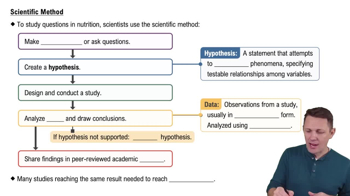
Scientific Method
554
views
12
rank
04:27
Clinical Trials
447
views
8
rank
이 집합의 용어 (30)
하이드의 정의
What is the science of nutrition?
The study of how food affects the body’s functions and health.
Name the main functions of nutrients.
Provide energy, build and repair tissues, regulate body processes.
Which nutrients produce energy?
Carbohydrates, fats, and proteins are energy-producing nutrients.
What are DRIs in nutrition?
Dietary Reference Intakes
are nutrient intake standards to guide healthy eating.
List the basic steps of the scientific method.
Observation, hypothesis, experiment, analysis, conclusion.
What are the 3 basic types of nutrition research?
Experimental, observational, and epidemiological studies.
How can you assess the credibility of nutrition information?
Check sources, look for scientific evidence, and verify author credentials.
What is a registered dietitian (RD)?
A nutrition expert credentialed to provide evidence-based dietary advice.
Define a healthful diet.
A diet that provides adequate nutrients, variety, balance, and moderation.
What is nutrient density?
The amount of nutrients per calorie in a food.
Name factors that influence food choices.
Culture, environment, emotions, habits, and health concerns.
What information is required on food labels?
Serving size, calories, nutrients, % Daily Value, ingredients.
How do you calculate calories from nutrients on a food label?
Multiply grams of carbs and protein by 4, fat by 9, then sum.
What are nutrition claims on food packages?
Statements about nutrient content or health benefits, regulated by law.
What are the Dietary Guidelines?
Science-based recommendations to promote health and prevent disease.
Describe the MyPlate graphic.
A visual guide showing recommended portions of food groups on a plate.
How can you make healthy choices when eating out?
Choose smaller portions, vegetables, lean proteins, and limit fried foods.
What role does the brain play in eating decisions?
It regulates hunger, appetite, and satiety through signals and hormones.
Name hormones involved in eating regulation.
Ghrelin stimulates hunger; leptin promotes satiety.
What is satiety?
The feeling of fullness that stops eating.
Outline the path food takes through the digestive tract.
Mouth → esophagus → stomach → small intestine → large intestine → rectum.
What are sphincters in digestion?
Muscle rings that control food passage between digestive organs.
Name key digestive enzymes and their functions.
Amylase breaks down carbs, protease breaks down proteins, lipase breaks down fats.
Where does digestion, absorption, and elimination occur?
Digestion: stomach and small intestine; absorption: small intestine; elimination: large intestine.
How are nutrients transported from the GI tract to cells?
Via the bloodstream and lymphatic system after absorption.
What are accessory organs in digestion?
Organs like the pancreas, liver, and gallbladder that aid digestion.
Name common GI disorders related to digestion and absorption.
Lactose intolerance, celiac disease, acid reflux, irritable bowel syndrome.
How can GI disorders be alleviated?
Diet changes, medications, and avoiding trigger foods.
What is the difference between allergy and intolerance?
Allergy involves immune response; intolerance involves digestive difficulty.
What is celiac disease?
An autoimmune disorder triggered by gluten causing intestinal damage.
 뒤로뒤로
뒤로뒤로
 04:30
04:30