Skip to main content
Organic Chemistry
나의 코스
배우기
시험 준비
AI 튜터
학습 가이드
교과서적 해결책
플래시카드
탐험해 보세요
앱을 사용해 보세요
나의 코스
배우기
시험 준비
AI 튜터
학습 가이드
교과서적 해결책
플래시카드
탐험해 보세요
앱을 사용해 보세요
뒤로
Calculations with Enantiomeric Percentages quiz
카드를 뒤집기 위해 탭할 수 있습니다.
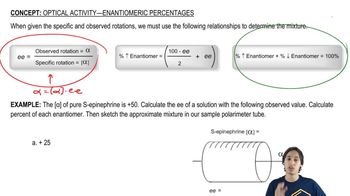
What is the equation relating observed rotation, specific rotation, and enantiomeric excess (ee)?
카드를 뒤집기 위해 탭할 수 있습니다.
👆
What is the equation relating observed rotation, specific rotation, and enantiomeric excess (ee)?
Observed rotation equals specific rotation times enantiomeric excess (ee).
진행 상황 추적
컨트롤 버튼이 '내비게이션' 모드로 변경되었습니다.
1/15
관련 플래시카드
관련 실천
추천 영상
Calculations with Enantiomeric Percentages definitions
Calculations with Enantiomeric Percentages
15 용어
Calculations with Enantiomeric Percentages
5. Chirality
5 문제점
주제
Ernest
Non-Carbon Chiral Centers
5. Chirality
1 문제
주제
Ernest
5. Chirality - Part 1 of 4
4 주제
15 문제점
장
Johnny
5. Chirality - Part 2 of 4
6 주제
15 문제점
장
Johnny
5. Chirality - Part 3 of 4
6 주제
15 문제점
장
Johnny
5. Chirality - Part 4 of 4
2 주제
5 문제점
장
03:08
Calculating EE, percent of each enantiomer, and sketching mixture
2269
views
8
rank
1
comments
03:23
How to solve for the percentage of each enantiomer.
2272
views
10
rank
이 집합의 용어 (15)
하이드의 정의
What is the equation relating observed rotation, specific rotation, and enantiomeric excess (ee)?
Observed rotation equals specific rotation times enantiomeric excess (ee).
How do you solve for enantiomeric excess (ee) if given observed and specific rotation?
Enantiomeric excess (ee) is calculated by dividing the observed rotation by the specific rotation.
What is the sum of the percentages of the higher and lower enantiomers in a mixture?
The sum of the percentages of the higher and lower enantiomers always equals 100%.
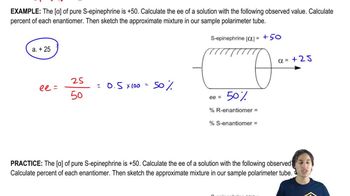
If the specific rotation of pure s-epinephrine is +50 and the observed rotation is +25, what does this indicate about the mixture?
It indicates that the mixture contains both enantiomers and is not pure s-epinephrine.
How do you calculate the percentage of the higher enantiomer from most enantiomeric excess values?
You use the formula: percentage of higher enantiomer = (enantiomeric excess + 100) / 2.
How do you find the percentage of the lower enantiomer once you know the higher enantiomer's percentage?
Subtract the percentage of the higher enantiomer from 100% to get the lower enantiomer's percentage.
What does an observed rotation of +25 mean if the specific rotation is +50?
It means the enantiomeric excess is 50%, indicating a mixture with more of the s-enantiomer but not pure.
Why is the observed rotation less than the specific rotation in a mixture of enantiomers?
Because the presence of both enantiomers causes partial cancellation of optical activity, reducing the observed rotation.
What is the enantiomeric excess (ee) if the observed rotation is +25 and the specific rotation is +50?
The enantiomeric excess (ee) is 50%.
If the enantiomeric excess is 50%, what are the percentages of the higher and lower enantiomers?
The higher enantiomer is 75% and the lower enantiomer is 25%.
What does a 50:50 mixture of enantiomers result in regarding optical rotation?
A 50:50 mixture results in zero observed optical rotation because the rotations cancel each other out.
How can you visualize the mixture of enantiomers in a polarimeter tube?
You can sketch the tube with sections representing the percentages of each enantiomer, such as 75% s and 25% r.
Why do we only get half the efficacy (rotation) when the mixture is not pure?
Because the lower enantiomer partially cancels the optical activity of the higher enantiomer, reducing the observed rotation.
What is the relationship between enantiomeric excess and optical activity?
Enantiomeric excess directly determines the proportion of optical activity observed compared to the pure enantiomer.
What is the first step in solving for enantiomeric percentages when given observed and specific rotation?
The first step is to calculate the enantiomeric excess (ee) using the observed and specific rotation values.
 뒤로뒤로
뒤로뒤로

 03:08
03:08