Skip to main content
Organic Chemistry
나의 코스
배우기
시험 준비
AI 튜터
학습 가이드
교과서적 해결책
플래시카드
탐험해 보세요
앱을 사용해 보세요
나의 코스
배우기
시험 준비
AI 튜터
학습 가이드
교과서적 해결책
플래시카드
탐험해 보세요
앱을 사용해 보세요
뒤로
Organic Chemistry: Infrared and Mass Spectrometry Fundamentals
카드를 뒤집기 위해 탭할 수 있습니다.
What does infrared (IR) spectroscopy measure in a molecule?
카드를 뒤집기 위해 탭할 수 있습니다.
👆
What does infrared (IR) spectroscopy measure in a molecule?
IR spectroscopy
measures the
bond vibration frequencies
to identify functional groups.
진행 상황 추적
컨트롤 버튼이 '내비게이션' 모드로 변경되었습니다.
1/20
추천 영상
05:41
Reason for Analytical Methods
3463
views
78
rank
3
comments
이 집합의 용어 (20)
하이드의 정의
What does infrared (IR) spectroscopy measure in a molecule?
IR spectroscopy
measures the
bond vibration frequencies
to identify functional groups.
How are frequency and wavelength related in electromagnetic radiation?
Frequency (ν) and wavelength (λ) are
inversely proportional
, related by \(c=\lambda \nu\) where c is the speed of light.
What is the typical wavelength range for infrared radiation?
Infrared wavelengths range from about
2.5 × 10
-4
cm to 25 × 10
-4
cm
.
What determines the frequency of bond stretching vibrations in IR spectroscopy?
Frequency depends on
bond stiffness (bond energy)
and
atomic masses
of the bonded atoms.
How does atomic mass affect stretching frequency?
Heavier atoms cause
lower stretching frequencies
due to decreased vibration frequency.
How does bond energy affect stretching frequency?
Stronger bonds have
higher stretching frequencies
because they are stiffer.
What are the three fundamental vibrational modes of water?
Water has
symmetric stretching
,
antisymmetric stretching
, and
bending (scissoring)
vibrational modes.
What is the 'fingerprint region' in an IR spectrum?
The fingerprint region is from
600 to 1400 cm
-1
and contains complex vibrations unique to each molecule.
What makes a vibration IR-active?
A vibration is IR-active if it involves a
change in dipole moment
, typically in polar bonds.
How does conjugation affect C=C stretching frequency?
Conjugation
lowers
the C=C stretching frequency compared to isolated double bonds.
Order the C-H stretching frequencies by hybridization from lowest to highest.
sp3
C-H: ~2800-3000 cm
-1
,
sp2
C-H: ~3000-3100 cm
-1
,
sp
C-H: ~3300 cm
-1
(sharp).
What IR absorption is characteristic of alcohol O-H stretching?
A broad, intense absorption centered around
3300 cm
-1
due to hydrogen bonding.
How can you distinguish primary, secondary, and tertiary amines in IR spectra?
Primary amines show
two sharp N-H spikes
, secondary amines show
one sharp spike
, and tertiary amines show
no N-H stretch
.
Where do carbonyl (C=O) stretches typically appear in IR spectra?
Around
1710 cm
-1
for ketones, aldehydes, and carboxylic acids.
How does conjugation affect the C=O stretching frequency?
Conjugation lowers the C=O stretch to about
1680 cm
-1
.
What is the typical IR absorption range for nitrile (C≡N) stretching?
A strong, sharp absorption just above
2200 cm
-1
.
What is the base peak in a mass spectrum?
The base peak is the
tallest peak
and is assigned 100% relative abundance.
What is a radical cation in mass spectrometry?
A molecule that has lost one electron, carrying a
positive charge and an unpaired electron
.
What does high-resolution mass spectrometry (HRMS) provide?
HRMS measures masses with high accuracy (~1 part in 20,000) to determine exact molecular formulas.
How do isotopes affect mass spectra?
Isotopes cause characteristic M+1 and M+2 peaks; e.g., bromine shows nearly equal M and M+2 peaks due to 79Br and 81Br isotopes.
 뒤로뒤로
뒤로뒤로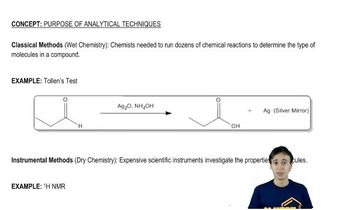
 05:41
05:41