Ch. 10 - Reactions of Alcohols, Ethers, Epoxides, Amines, and Sulfur-Containing Compounds
Bruice - Organic Chemistry 8th Edition
Bruice8th EditionOrganic ChemistryISBN: 9780135213711당신이 사용하는 게 아니라요?교과서 변경
10장, 문제 44

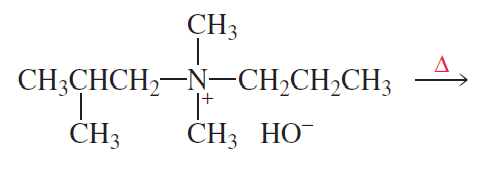
What are the major products of the following reaction?
Chemical structure of an amine with a heat symbol indicating a reaction, showing reactants and a hydroxide ion.

검증된 단계별 안내
1
Analyze the given reaction: Identify the reactants, reagents, and reaction conditions. This will help determine the type of reaction mechanism involved (e.g., substitution, elimination, addition, etc.).
Determine the functional groups present in the reactant and how they might interact with the reagent. For example, if the reagent is a strong base, consider elimination reactions; if it is a nucleophile, consider substitution reactions.
Predict the reaction mechanism: Based on the reaction conditions (e.g., heat, solvent, reagent strength), decide whether the reaction proceeds via SN1, SN2, E1, or E2 mechanisms, or if it involves other pathways like electrophilic addition or rearrangements.
Draw the possible intermediates or transition states: For example, if the reaction involves a carbocation intermediate (as in SN1 or E1), consider whether rearrangements or resonance stabilization might occur.
Identify the major products: Based on the stability of the products (e.g., Zaitsev's rule for elimination, Markovnikov's rule for addition), predict the most likely major product(s) and ensure stereochemistry is considered if applicable.

비슷한 문제에 대한 검증된 영상 답변:

이 영상 해법은 위 문제에 도움이 된다고 튜터들이 추천한 것입니다.
영상 길이:
4m

주요 개념

질문에 올바르게 답하기 위해 반드시 이해해야 하는 핵심 개념들은 다음과 같습니다.

Reaction Mechanisms

Understanding reaction mechanisms is crucial in organic chemistry as they describe the step-by-step process by which reactants transform into products. This includes identifying intermediates, transition states, and the types of bonds formed or broken during the reaction. Knowledge of mechanisms helps predict the major products based on the stability of intermediates and the energy changes involved.
추천 영상:
02:16
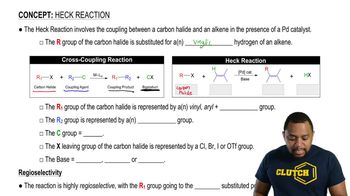
Heck Reaction Mechanism

Functional Groups

Functional groups are specific groups of atoms within molecules that are responsible for the characteristic chemical reactions of those molecules. Recognizing functional groups in the reactants allows chemists to anticipate the types of reactions that may occur and the products that will be formed. Different functional groups can lead to different reaction pathways and product distributions.
추천 영상:
02:36
Identifying Functional Groups

Regioselectivity and Stereoselectivity

Regioselectivity refers to the preference of a chemical reaction to occur at one location over another in a molecule, while stereoselectivity involves the preference for forming one stereoisomer over another. These concepts are essential for predicting the major products of a reaction, as they influence the outcome based on the structure of the reactants and the conditions of the reaction.
추천 영상:
05:09
Heck Reaction