Ch. 10 - Reactions of Alcohols, Ethers, Epoxides, Amines, and Sulfur-Containing Compounds
Bruice - Organic Chemistry 8th Edition
Bruice8th EditionOrganic ChemistryISBN: 9780135213711당신이 사용하는 게 아니라요?교과서 변경
10장, 문제 60d

What is the major product obtained from the reaction of 2-ethyloxirane with each of the following reagents?
d. CH3OH/CH3O-

검증된 단계별 안내
1
Identify the structure of 2-ethyloxirane. It is a three-membered cyclic ether (epoxide) with an ethyl group attached to one of the carbons in the ring.
Understand the reactivity of epoxides. Epoxides are highly strained and reactive, and they undergo ring-opening reactions in the presence of nucleophiles. The reaction can proceed under basic or acidic conditions. In this case, CH3O- (methoxide) is a strong nucleophile, and the reaction occurs under basic conditions.
Determine the regioselectivity of the reaction. Under basic conditions, the nucleophile (CH3O-) attacks the less substituted carbon of the epoxide due to steric hindrance. This results in the opening of the epoxide ring.
Write the mechanism of the reaction. The methoxide ion (CH3O-) attacks the less substituted carbon of the epoxide, breaking the C-O bond and forming an alkoxide intermediate. The intermediate is then protonated by CH3OH (methanol), yielding the final product.
Draw the major product. The product will be a molecule where the methoxy group (-OCH3) is attached to the less substituted carbon of the original epoxide, and the hydroxyl group (-OH) is attached to the more substituted carbon.

비슷한 문제에 대한 검증된 영상 답변:

이 영상 해법은 위 문제에 도움이 된다고 튜터들이 추천한 것입니다.
영상 길이:
3m

주요 개념

질문에 올바르게 답하기 위해 반드시 이해해야 하는 핵심 개념들은 다음과 같습니다.

Epoxide Reactivity

Epoxides, or oxiranes, are three-membered cyclic ethers that are highly reactive due to the strain in their ring structure. They can undergo nucleophilic ring-opening reactions, where a nucleophile attacks one of the carbon atoms in the epoxide, leading to the formation of a more stable product. The nature of the nucleophile and the reaction conditions can significantly influence the regioselectivity and stereochemistry of the resulting product.
추천 영상:
02:19
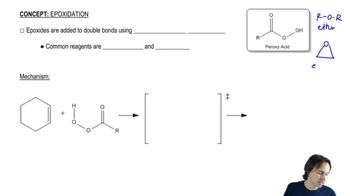
General properties of epoxidation.

Nucleophilic Substitution

Nucleophilic substitution is a fundamental reaction mechanism in organic chemistry where a nucleophile replaces a leaving group in a molecule. In the case of epoxides, the nucleophile attacks the less hindered carbon atom, leading to the opening of the epoxide ring. The choice of nucleophile, such as methanol (CH3OH) in this question, determines the nature of the product formed, often resulting in the formation of an alcohol.
추천 영상:
01:47
Nucleophiles and Electrophiles can react in Substitution Reactions.

Regioselectivity

Regioselectivity refers to the preference of a chemical reaction to yield one structural isomer over others when multiple possibilities exist. In the context of epoxide reactions, the regioselectivity is influenced by steric and electronic factors, which dictate which carbon atom in the epoxide is attacked by the nucleophile. Understanding regioselectivity is crucial for predicting the major product in reactions involving epoxides and various nucleophiles.
추천 영상:
05:09
Heck Reaction